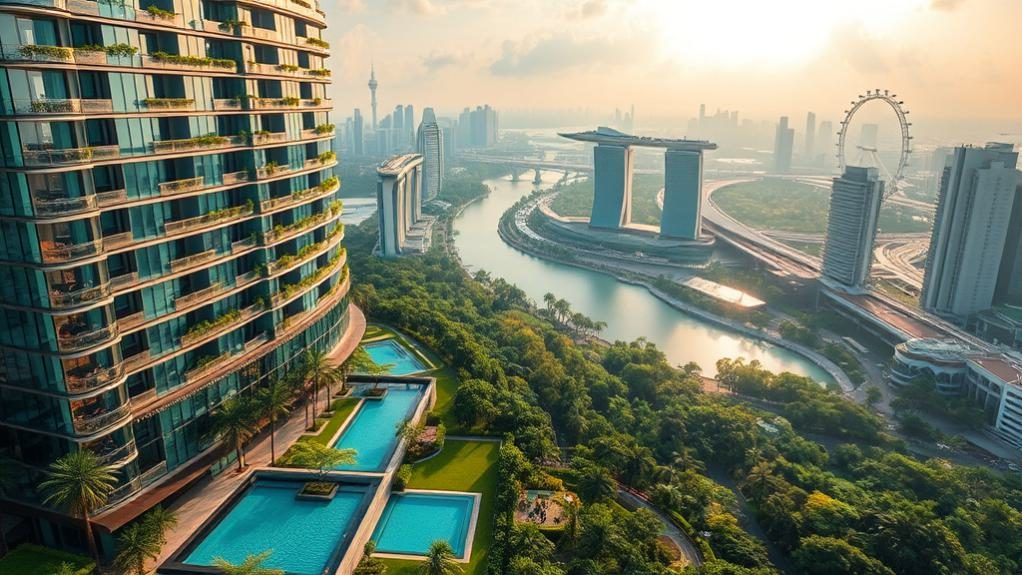
Singapore’s prime residential property market operates under one of the strictest transaction tax environments globally. Following policy adjustments in April 2023, the Additional Buyer’s Stamp Duty (ABSD) for foreign individuals buying any residential property doubled from 30% to 60%. Despite this substantial friction, transaction activity in the Core Central Region (CCR) has not ground to a halt. Instead, the market has undergone a structural pivot, shifting reliance away from speculative cross-border capital toward well-capitalized domestic buyers, permanent residents, and specific institutional family structures.
The 60% Foreign ABSD Threshold and Market Restructuring
The implementation of the 60% headline ABSD rate marked an intentional regulatory effort by the Ministry of National Development and Ministry of Finance to prioritize housing availability for Singapore citizens. Foreign buyers without free trade agreement exemptions now face an upfront tax hurdle that significantly alters purchasing calculations. For instance, an overseas buyer acquiring an S$8 million luxury apartment in District 9 or 10 must commit S$4.8 million purely in ABSD before factoring in standard buyer duties and legal expenses.
Full statutory rate tables and remission criteria are detailed by the Inland Revenue Authority of Singapore (IRAS). While foreign transaction volume dropped from approximately 14% of CCR non-landed sales to under 6% following the hike, certain nationalities retain relief. Citizens and permanent residents of Iceland, Liechtenstein, Norway, Switzerland, and United States nationals qualify for national treatment under their respective Free Trade Agreements. For other foreign high-net-worth individuals, direct retail acquisition has yielded to longer-term wealth structuring, corporate business relocations, or leasing prime residences rather than purchasing outright.
Progressive Buyer Stamp Duty at the Top End
Beyond ABSD, luxury acquisitions in Singapore must account for progressive Buyer’s Stamp Duty (BSD), which was restructured in Budget 2023. Residential properties face higher marginal brackets for higher-tier purchase values: 4% applies to values between S$1 million and S$1.5 million, 5% applies between S$1.5 million and S$3 million, and any consideration exceeding S$3 million incurs a top rate of 6%.
Buyers can review the official bracket breakdown directly via the IRAS Buyer’s Stamp Duty guidelines. On an S$10 million prime penthouse purchase, the standard BSD alone totals S$469,600. When combined with foreign ABSD, upfront tax liability reaches S$6.47 million, effectively requiring over 64% of the property value in cash or CPF before construction or ownership begins. Understanding these tax tiers is essential, as detailed in our guide on Singapore property cooling measures explained.
Total Debt Servicing Ratio and Financing Discipline
Unlike previous speculative property cycles in Asian markets, luxury purchases in Singapore are anchored by conservative macroprudential borrowing rules. Under the Total Debt Servicing Ratio (TDSR) framework administered by the Monetary Authority of Singapore (MAS), a borrower’s monthly debt obligations across all financial institutions cannot exceed 55% of their gross monthly income.
In addition, residential mortgages are evaluated against an interest rate stress test floor of 4.0% per annum, or the prevailing market rate plus a buffer, whichever is higher. Regulatory parameters are set out in the MAS TDSR regulatory explainer. These loan restrictions require affluent buyers to contribute substantial upfront equity. Lenders also apply haircuts ranging from 30% to 70% on variable income, performance bonuses, rental income, and pledged financial assets when assessing borrowing eligibility. As a result, forced liquidations during economic downturns remain exceptionally rare in prime central Singapore.
Another area of rigorous enforcement involves purchases made through trust structures. Under Section 22B of the Stamp Duties Act, an upfront ABSD of 65% applies to any transfer of residential property into a trust. While a trustee can submit an application to IRAS for a remission if the beneficiary is an identifiable Singapore citizen child without existing homeownership, the transaction must be financed entirely in cash, as commercial mortgage lenders do not extend housing loans on properties held under bare trusts for minors. Furthermore, IRAS actively audits artificial fractional ownership arrangements, such as 99-to-1 structures, applying a mandatory 50% statutory surcharge on clawed-back duties under Section 33A anti-avoidance powers.
Core Central Region Volumes and the Domestic Wealth Pivot
With speculative foreign demand curtailed, the composition of CCR buyers has tilted decisively toward domestic citizens and Singapore Permanent Residents. Data indicates that domestic buyers now account for over 90% of prime condo purchases. Many transactions involve affluent local business owners, tech executives, medical specialists, and multi-generational families acquiring real estate for family legacy or personal occupation.
Buyers looking at prime properties often consider purchasing strategies such as single-owner titles or restructuring existing portfolios to avoid unnecessary tax exposures. However, buyers must be careful to avoid aggressive arrangements that fall foul of anti-avoidance audits, a topic examined in our review of common ABSD misconceptions. Genuine single-name ownership and natural wealth accumulation remain the standard route for local buyers securing high-value assets in Orchard, River Valley, and Tanglin.
Long-Term Capital Preservation in Prime Singapore Property
Despite lower transaction velocity compared to suburban regions, luxury home price indices in Singapore have shown notable price resilience rather than steep discounts. Developers holding high-end land banks have generally preferred phased releases over deep price slashing, supported by healthy balance sheets and manageable holding costs.
For high-net-worth investors, Singapore offers key structural merits that counterbalance high entry stamp duties: political stability, strong currency fundamentals in the Singapore Dollar, transparent legal protections for title ownership, and the absence of capital gains tax or estate duties. Prime real estate in Districts 9, 10, and 11 functions less as a vehicle for rapid trading gains and more as a durable capital preservation asset designed to shelter wealth across market cycles.
Compared to other regional financial centres such as Hong Kong or London, Singapore has intentionally maintained its cooling measures rather than rolling them back during market lulls. While this approach keeps transaction volumes subdued in absolute unit terms, it effectively insulates the domestic financial system from external leverage shocks. Wealthy investors recognize that the premium paid to enter Singapore real estate buys access to an orderly, predictable regulatory framework where abrupt currency depreciations or retroactive expropriations are virtually non-existent.