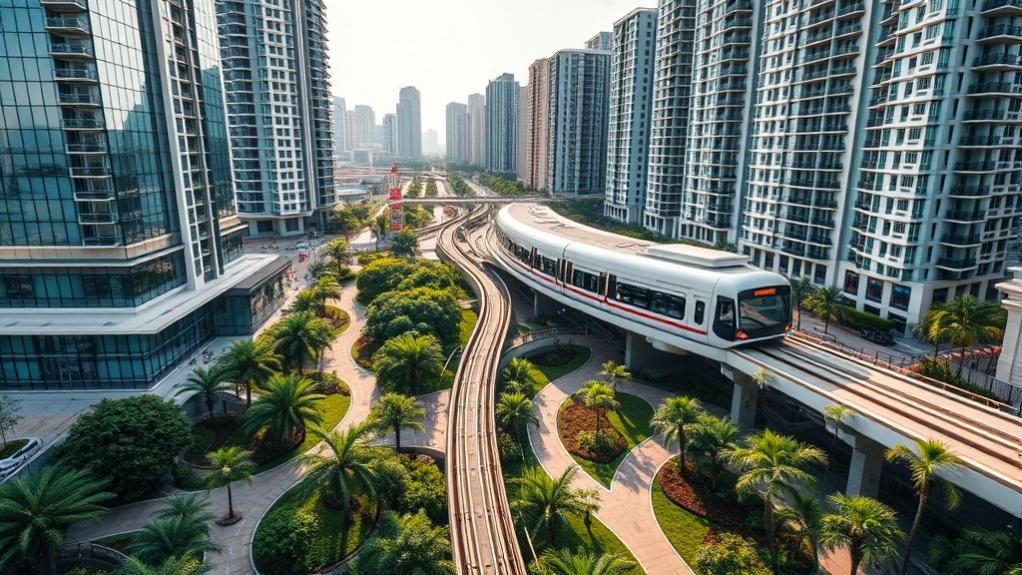
An MRT interchange can make a condominium more useful: residents gain access to more than one rail line, may avoid an extra transfer and have more route choices when part of the network is disrupted. That utility can matter to both owner-occupiers and tenants. It does not, however, create a standard price premium that applies to every condo near every interchange.
Singapore evidence supports a relationship between rail accessibility and housing value in particular settings. It also shows why buyers should be careful with broad claims. Station type, actual walking route, travel-time improvement, neighbourhood amenities, tenure, project age, unit attributes and market conditions can all move prices. The sensible question is therefore not “How much is the interchange premium?” but “How much additional utility does this interchange provide for this property, and is that benefit already reflected in the asking price?”
Why an interchange may be more useful than a single-line station
A nearby station provides access to the rail network; an interchange provides direct access to at least two lines. The difference is most valuable when the second line materially shortens trips to workplaces, schools or family, or offers a practical alternative route. It may be less important when both lines serve destinations the household rarely visits.
Network position matters as much as the interchange label. A condo beside an interchange with long internal transfer walks may not save as much door-to-door time as expected. Conversely, a home one stop from an interchange can deliver much of the network benefit without the foot traffic immediately around a major hub. LTA’s description of Cross Island Line Phase 2 illustrates the intended mechanism: its interchange stations are meant to improve connectivity, shorten some journeys and redistribute commuter load across the network. Buyers can review the confirmed alignment and opening assumptions on the LTA project page.
What Singapore research does—and does not—show
Evidence: Diao, Fan and Sing’s 2017 study used the opening of the Circle Line and non-landed private housing transactions from 2009 to 2013. It reported an average post-opening increase of 1.6%, with a larger estimated treatment effect for homes within 400 metres of the closest Circle Line stations relative to homes outside that treatment zone. A later spatial study of the Circle Line estimated an effect of about 8.6% within a 600-metre network-distance treatment area relative to its control area after accounting for spatial dependence. These are study-specific estimates, not a tariff for being near any MRT station or interchange.
The NUS Institute of Real Estate and Urban Studies review also highlights the other side of proximity. Research by Diao, Li, Sing and Zhan found evidence that noise from above-ground tracks can be capitalised as a disamenity, while noise barriers mitigated the discount. Taken together, the research says accessibility and nuisance can operate at the same time.
Limit: none of these findings establishes a universal, interchange-only premium. The Circle Line studies concern a particular network expansion and defined treatment areas. Results for HDB flats, older periods or newly connected stations should not be transferred mechanically to a current condominium purchase. A price difference between two projects is not proof that an interchange caused it.
Why observed prices can mislead
Interchanges often sit in mature town centres or planned mixed-use nodes. Such locations may also have malls, offices, bus interchanges, healthcare, schools and newer developments. A higher price may reflect that bundle rather than the rail connection alone. New projects can also differ from resale comparables in age, facilities, layout efficiency, lease balance and developer pricing.
Even project-level averages can conceal substantial variation. Floor, facing, renovation, noise exposure, view and unit size affect the transacted price per square foot. URA explains that its broad private residential price indices use hedonic regression to control for attributes such as age and unit size; an individual buyer comparing a handful of transactions does not automatically have those controls. Use the URA property market resources to check private residential transactions and rentals, then compare like with like within the same project and against genuinely similar nearby projects.
Measure access as a resident would experience it
A radius on a sales brochure is not a walking journey. Confirm the route from the development gate to the relevant station entrance, not merely the distance from the site boundary to the station marker. Roads, crossings, gradients, sheltered links, construction diversions and the position of the resident’s block can change the daily experience. The official SLA OneMap is a useful starting point for checking addresses, station infrastructure and the surrounding street network, but a site walk remains important.
Test a realistic weekday trip at the time it would normally be made. Include the walk, waiting time, interchange walk and last-mile connection. Check whether the second line removes a transfer or simply relocates it. Also visit during the evening peak and in wet weather. A direct underground or sheltered connection can have more practical value than a shorter unsheltered route.
Existing single-line projects provide useful counterpoints. For example, this site’s overview of a condo next to Springleaf MRT shows why direct line access can still be attractive without an interchange. The comparison should focus on destinations and total journey time, not station status alone.
Separate owner-occupier and investor decisions
For an owner-occupier, the benefit can be valued in recurring time saved and resilience. List each household member’s regular destinations, calculate realistic weekly savings and decide what that convenience is worth over the expected holding period. Families may reasonably pay more for a route that simplifies several daily journeys, but that is a personal willingness to pay—not a forecast of capital appreciation.
For an investor, tenant demand must be demonstrated rather than assumed. Compare achieved rents for similar units in the same development and nearby alternatives, account for maintenance fees and vacancy, and test whether the net yield still works at the proposed purchase price. An integrated project may combine transport and retail convenience; this article on a Tampines development with MRT access is a reminder that buyers must separate the value of the station from on-site amenities and the new-build proposition.
Future interchanges require an additional discount for timing and execution. Distinguish announced alignments from stations under construction and operating connections. Benefits may be anticipated in land bids or asking prices years before opening, while construction disruption is immediate. Do not pay today as though every projected benefit were already delivered.
A practical comparison framework
- Connectivity: identify the destinations reached more quickly because of the second line and calculate door-to-door, not train-only, time.
- Physical access: walk from the actual block and gate to the correct entrance; note shelter, crossings and internal transfer distance.
- Comparable evidence: use recent caveated transactions and achieved rents for similar tenure, age, size, floor and condition.
- Disamenities: inspect for track, road and crowd noise, privacy exposure, station servicing activity and peak-hour congestion.
- Price discipline: compare the subject unit with a nearby single-line or one-stop-away alternative, then quantify the extra amount being asked.
- Scenario risk: model owner use or net rental yield without assuming a guaranteed premium, faster resale or above-market appreciation.
An MRT interchange is best treated as one locational attribute within a complete property comparison. Research gives good reason to value genuine accessibility gains, but not to accept a generic percentage uplift. Buyers who verify the route, compare controlled transaction evidence and price the benefit according to their own travel needs are less likely to confuse connectivity with an investment guarantee.


One thought on “How MRT Interchanges Affect Singapore Condo Decisions”