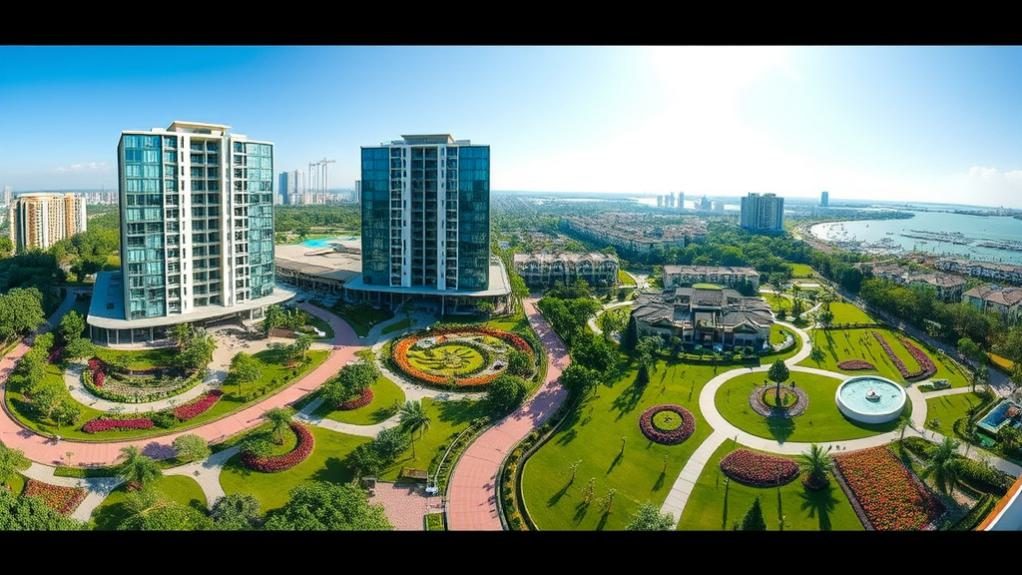
Executive condominiums in Sengkang have emerged as one of the most active segments of Singapore’s suburban housing market. Located in the northeast region, Sengkang has evolved from an emerging satellite town into a mature residential district populated by thousands of young families and upgraders. As several prominent executive condominium developments surpass their initial five-year Minimum Occupation Period and approach their ten-year mark for full privatization, transaction volumes and resale price benchmarks have reflected robust buyer interest under policies established by the Housing & Development Board.
Sengkang’s Executive Condominium Cluster and MOP Timelines
Sengkang hosts an extensive cluster of executive condominiums built over the past decade. Notable projects include The Vales and Bellewaters along Anchorvale Crescent, Treasure Crest along Anchorvale Crescent, Rivercove Residences along Anchorvale Lane, and earlier developments such as RiverParc Residence and Ecopolitan along the Punggol border. These developments were originally launched to serve eligible sandwich-class Singaporean households who exceeded the income limits for standard Build-To-Order flats but found private condominiums financially demanding.
The timeline of these projects is critical for market participants. The Vales and Bellewaters completed their construction and attained Temporary Occupation Permit status in 2017, crossing their five-year MOP milestone in 2022 and moving steadily toward full privatization around 2027. Treasure Crest reached MOP in 2023, while Rivercove Residences completed its MOP cycle in 2025. This sequential release of completed units into the open market has provided a continuous pipeline of relatively modern, full-facility condominium units for buyers seeking suburban homes.
Public to Private Evolution: 5-Year MOP Versus 10-Year Privatization
The statutory structure governing executive condominiums defines two distinct phases of market eligibility. During the initial five years following key collection, owners must occupy the flat and cannot sell the property or rent out the entire unit on the open market. Once the five-year MOP is fulfilled, the development enters its semi-privatized phase. In this window between years six and ten, owners may sell their units on the open resale market, but purchasers must be Singapore Citizens or Singapore Permanent Residents.
Crucially, the household income ceiling that governs brand-new EC purchases from developers (currently capped at S$16,000 monthly) ceases to apply on the resale market. Buyers can purchase resale units regardless of household earnings. Once the development completes ten years from TOP, the property achieves full privatization. At this stage, all HDB housing restrictions fall away entirely, allowing foreign buyers and corporate entities to acquire units under the same terms as standard private properties, a progression explained in detail in our analysis of Singapore property progression from BTOs to ECs and private condos.
Mortgage Financing Differences: MSR for New ECs Versus TDSR for Resale
One of the most consequential yet misunderstood distinctions between new-launch and resale executive condominiums lies in mortgage financing rules. When buyers purchase a new EC directly from a property developer, financial institutions must apply the Mortgage Servicing Ratio cap. Under the MSR, monthly loan repayments cannot exceed 30% of the household’s gross monthly income. This 30% cap severely limits borrowing capacity, often requiring purchasers to make substantial cash top-ups to bridge the gap between their loan eligibility and the purchase price.
Resale ECs, by contrast, are treated as private residential properties for mortgage assessment purposes under regulatory guidelines set by the Monetary Authority of Singapore. Buyers are assessed exclusively under the Total Debt Servicing Ratio framework. The TDSR framework allows borrowers to allocate up to 55% of their gross monthly income across all debt commitments, including home loans, car loans, and personal credit lines. Because TDSR provides an allowable debt ceiling nearly double that of MSR, middle-income buyers frequently discover they can secure substantially higher loan quantum for a resale EC than for a new-launch EC, expanding their purchasing options.
Upgrader Demographics and Northeast Transport Infrastructure
Sengkang possesses a unique demographic profile that supports ongoing resale demand. The town contains dozens of large-scale Build-To-Order precincts in Anchorvale, Compassvale, Fernvale, and Rivervale that have crossed their own five-year MOP marks. Many young couples who bought subsidised HDB flats early in their careers have experienced salary growth and accumulated substantial equity in their flats. For these homeowners, upgrading to an EC within Sengkang allows them to remain close to parents, familiar schools, and community amenities without leaving their social network.
Infrastructure enhancements have reinforced this appeal. The integrated transport hub at Sengkang MRT station connects directly to the North-East Line and the Sengkang LRT network, offering seamless transit to Dhoby Ghaut and the Central Business District. Commercial amenities including Compass One, Rivervale Mall, and the integrated community hub at Sengkang Grand Mall provide retail and dining convenience. Furthermore, medical infrastructure anchored by Sengkang General Hospital and Sengkang Community Hospital ensures comprehensive healthcare accessibility within the neighborhood.
Buyer Considerations: CPF Usage, Valuation, and Long-Term Capital Retention
Prospective buyers evaluating resale executive condominiums must conduct thorough financial due diligence before committing to an Option to Purchase. Resale EC buyers are not eligible for CPF housing grants, meaning the purchase relies entirely on personal savings, CPF Ordinary Account balances, and bank financing. When planning their funding structure, buyers should verify their available CPF withdrawal limits under rules administered by the Central Provident Fund Board, ensuring adequate reserves remain for retirement adequacy.
Additionally, while resale ECs historically offer an attractive pricing discount compared to newly launched private condominiums, buyers must evaluate maintenance fees, sinking fund contributions, and the remaining lease tenure. Comparing unit layouts and historical price trends across individual projects is essential to ensure long-term capital retention, a consideration highlighted in our guide on trade-offs between executive condominiums and private condos.


One thought on “Why Sengkang Executive Condominiums Drive Strong Resale Demand”