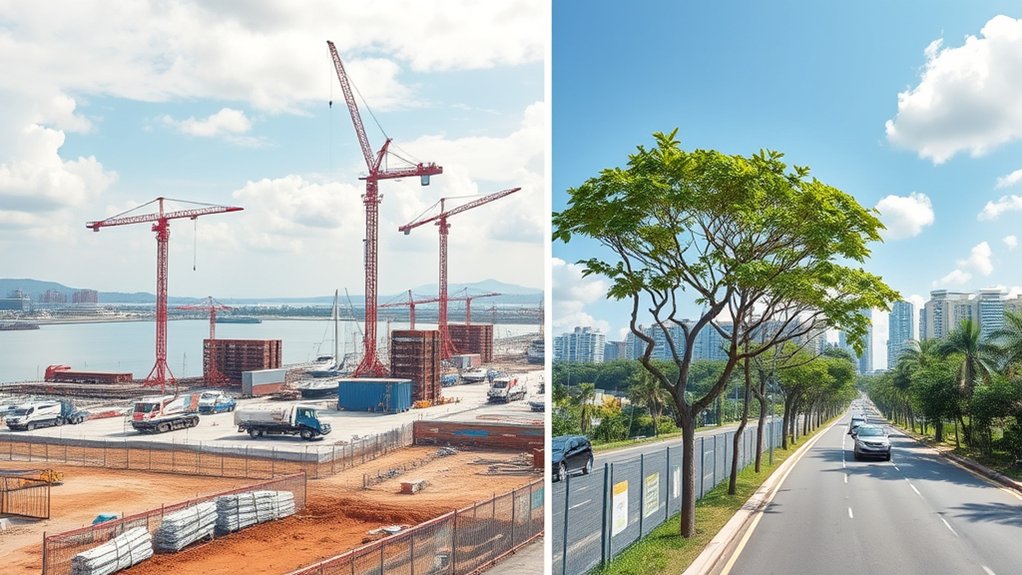
URA has put two 99-year leasehold residential parcels on the market under the second-half 2026 Government Land Sales (GLS) programme. Marina Gardens Lane could supply about 390 homes, while Orchard Boulevard could add about 110. Together, the sites represent roughly 500 potential homes, but they are not interchangeable opportunities: one is a high-density, mixed-use plot in an emerging Marina South neighbourhood; the other is a compact residential site in an established prime district.
According to URA’s 13 August 2026 release, both plots are on the Confirmed List. That means they are launched for sale according to the programme’s schedule, rather than waiting for a successful developer application under the Reserve List.
The two GLS sites at a glance
| Detail | Marina Gardens Lane | Orchard Boulevard |
|---|---|---|
| Site area | 6,007.4 sq m | 3,438.0 sq m |
| Maximum gross floor area | 33,642 sq m | 9,627 sq m |
| Estimated housing yield | 390 units | 110 units |
| Land-use zoning | Residential with commercial at first storey | Residential |
| Gross plot ratio | About 5.6 | About 2.8 |
| Lease | 99 years | 99 years |
| Tender closes | 15 October 2026, 12 noon | 29 October 2026, 12 noon |
URA describes the housing numbers as estimates, so the eventual unit counts may vary. The figures nevertheless show the basic contrast. Marina Gardens Lane has around 3.5 times the maximum floor area and a substantially higher estimated housing yield. Orchard Boulevard is designed for a much smaller development.
Marina Gardens Lane: a dense mixed-use plot in a new district
The Marina Gardens Lane tender page confirms a 6,007.4 sq m site, maximum gross floor area of 33,642 sq m and zoning for residential use with commercial space at the first storey. The parcel is near Marina South MRT station and carries an estimated yield of 390 homes.
Its gross plot ratio of about 5.6 points to a more intensive form of development than the Orchard site. This does not by itself determine the final building configuration, unit sizes or facilities. Those details will depend on the winning developer’s design and the tender controls. Buyers should therefore avoid translating a high plot ratio directly into assumptions about any specific tower form or lifestyle offering.
The wider setting is equally important. URA’s Master Plan 2025 material for Marina South describes a 45-hectare mixed-use residential neighbourhood planned for more than 10,000 homes. It also sets out a “10-minute neighbourhood” concept, with daily needs intended to be within a short walk or cycle and weather-protected connections planned between developments and the Marina South Thomson-East Coast Line stations.
That planning vision is meaningful, but it should be read as a long-term district framework rather than proof that every amenity will be available when the first residents move in. Marina South is still being built out in stages. Our earlier report on the Marina Gardens Crescent GLS launch provides useful background on the government’s first major land release for the precinct.
Orchard Boulevard: a smaller site in an established prime location
URA’s Orchard Boulevard tender details show a 3,438 sq m residential parcel with up to 9,627 sq m of gross floor area. Its estimated 110-home yield makes it a boutique-scale opportunity compared with Marina Gardens Lane. The site is near Orchard Boulevard MRT station and the Orchard Road and Tanglin areas.
The key difference is not simply “prime versus non-prime”. Orchard Boulevard sits within an established urban environment where transport, retail, hotels, healthcare and dining already exist nearby. Marina South, by contrast, offers participation in a planned new neighbourhood whose full network of homes and amenities will emerge progressively. Orchard’s established context may be easier for buyers to assess today, while Marina South requires closer attention to phasing and future district delivery.
Orchard Boulevard’s smaller land area and lower gross floor area also mean it should not be evaluated using the same expectations as a larger project. A development of about 110 units may offer a more intimate residential proposition, but its actual facilities, maintenance costs, unit mix and pricing remain unknown before a project is designed and launched. For a nearby market reference, readers can review the earlier UpperHouse launch coverage; it is a separate project on a different GLS parcel and should not be treated as a direct forecast for this site.
How the sites differ for future homebuyers
Neighbourhood maturity: Orchard Boulevard is surrounded by a functioning prime-city district. Marina Gardens Lane belongs to a new precinct where the public realm, supporting uses and resident population will grow over time.
Development scale: Marina Gardens Lane is expected to provide 390 homes and includes first-storey commercial use. Orchard Boulevard’s 110-home estimate and pure residential zoning indicate a smaller project, although the final product is for the future developer to determine.
Planning proposition: Marina South’s appeal is tied partly to a coordinated district plan, including walkability, greenery and mixed uses. Orchard Boulevard’s case rests more on an existing address and established access. Neither automatically makes one site “better”; they serve different preferences and risk tolerances.
Points that cannot yet be known: Land bids, launch prices, completion dates, layouts, maintenance fees and sales performance remain undetermined. Any bid-range or selling-price estimate published before the tenders close is an analyst opinion, not a tender fact.
Tender dates and the wider 2H2026 supply
The Marina Gardens Lane tender is scheduled to close at noon on 15 October 2026. Orchard Boulevard follows at noon on 29 October 2026. Tender outcomes will reveal how developers price the different opportunities, but URA retains the right to reject the highest or any bid. Until results are announced, the eventual developers and land rates are unknown.
The two sites form part of 4,745 residential units scheduled for release through the 2H2026 Confirmed List. URA says that half-year supply is more than 50% above the annual average Confirmed List supply over the previous 10 years. This is a comparison of scheduled land supply, not a promise that all 4,745 homes will reach the market at once. Each site follows its own tender, award, design, approval and construction timeline.
What to watch next
The first milestone is the number and value of bids received at each tender closing. After any award, the next useful details will be the successful developer, approved design, unit mix and expected launch timing. For Marina Gardens Lane, buyers should also track the delivery sequence for Marina South’s transport links, public spaces and everyday amenities. For Orchard Boulevard, the eventual project scale, unit mix and recurring costs will matter because a smaller development can have a different cost structure from a larger condominium.
For now, the clearest conclusion is that the 500-home headline combines two distinct land propositions. Marina Gardens Lane is the larger and denser mixed-use site within a district under development. Orchard Boulevard is the smaller residential plot within an established luxury corridor. Comparing them on verified site attributes—and separating official tender facts from market forecasts—gives future buyers a sounder starting point.


One thought on “Marina Gardens Lane and Orchard Boulevard GLS Sites Could Yield 500 Homes”