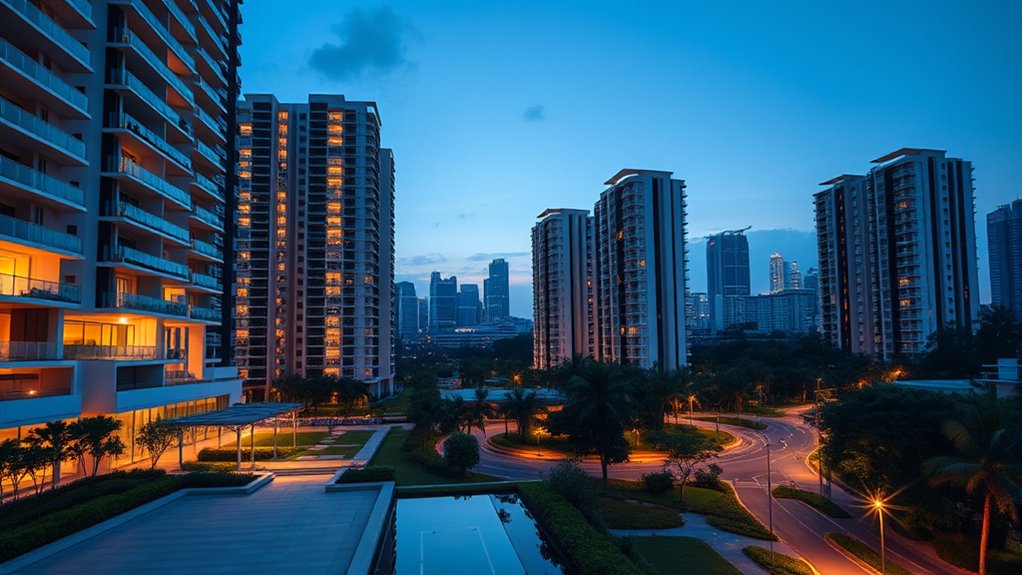
In the folklore of Singapore’s property market, few asset classes enjoy as legendary a reputation for wealth generation as the Executive Condominium (EC). Positioned as a subsidized public-private hybrid for the “sandwich class”—households exceeding the HDB income ceiling yet priced out of private luxury condominiums—ECs have historically delivered substantial capital gains for eligible Singaporean citizens upon completing their five-year Minimum Occupation Period (MOP).
Trophy transactions from past cycles—such as three- and four-bedroom units at Treasure Crest, Rivercove Residences, and Hundred Palms Residences transacting at resale gains of $500,000 to over $1,000,000—have entrenched the perception that buying a new EC is virtually an automatic capital windfall. But as Government Land Sales (GLS) tenders climb and cooling measures redefine the housing playbook, does this historic edge still exist for buyers entering the market today?
The Anatomy of Past EC Windfalls: The Golden 2013–2018 Vintage
To understand why past executive condominiums were exceptionally lucrative, one must examine the specific macroeconomic conditions of the 2013–2018 cycle. Following an oversupply of suburban land tenders and the introduction of the Total Debt Servicing Ratio (TDSR) framework in 2013, developer sentiment softened significantly.
During this window, developers secured state EC land at rates that appear astonishing in hindsight: $280 to $360 psf per plot ratio (psf ppr). When these developments launched between 2015 and 2018, average launch prices stood at just $750 to $850 psf. Buyers who purchased units during this period benefited from a double tailwind:
- The Post-MOP Privatisation Uplift: At the 5-year MOP milestone, the buyer pool expands to include Singapore Permanent Residents (PRs). At the 10-year mark, full privatisation permits sales to foreign purchasers.
- Macro Islandwide Price Inflation: Between 2018 and 2025, private residential property prices across Singapore surged by more than 40%, lifting private suburban launch benchmarks from $1,400 psf to well over $2,100 psf.
When these older projects exited MOP, their transacted prices naturally converged toward prevailing private condominium benchmarks, enabling owners to sell at $1,300 to $1,550 psf—translating to 60% to 90% capital returns on their initial acquisition price.
The Pricing Arbitrage: Why the EC Discount Remains Fundamental
Even in today’s higher-cost environment, the structural economic thesis underpinning the EC market remains intact: the pricing discount against comparable private new launches. By statutory design, the government releases EC land exclusively to eligible Singaporean households under a strict monthly household income ceiling (currently $16,000), exempting developers from paying full commercial land premiums.
Historically, this creates a 20% to 30% price gap between a new EC and an equivalent private condominium launched in the same suburban planning area. For example, while pure private OCR launches currently open between $2,150 and $2,450 psf, contemporary ECs such as Lumina Grand, Novo Place, and upcoming projects launch in the $1,450 to $1,650 psf range.
This entry-level price delta provides a built-in safety buffer. Even if the broader property market experiences a seasonal stagnation, the lower cost basis shields EC buyers from acute valuation declines while allowing them to service significantly smaller monthly mortgage obligations.
How the Landscape Has Changed: Higher Land Costs and Compressed Margins
Despite these strengths, it is critical for prospective buyers to recognize that the era of “easy double-your-money” windfalls has largely concluded. Three structural shifts have altered the profitability calculus:
1. Soaring Land Tender Costs
Recent GLS tenders reflect intense developer competition. Sites such as Woodlands Drive 17 (awarded at $782 psf ppr) and the recent Canberra Drive parcel (awarded at a record $825 psf ppr) mean that developer breakeven costs now comfortably exceed $1,380 psf. With launch prices pushed toward $1,550 to $1,650 psf, the percentage spread between entry pricing and future resale values is narrower than in the 2016 era.
2. Financing Caps Under MSR
Unlike private property buyers whose borrowing is capped only by the 55% Total Debt Servicing Ratio (TDSR), EC purchasers buying direct from developers are governed by the strict 30% Mortgage Servicing Ratio (MSR). This borrowing ceiling limits the maximum loan quantum a household earning under $16,000 can secure, forcing buyers to deploy larger upfront cash and CPF capital.
3. The Grandfathered vs New Regulatory Divide
A pivotal regulatory milestone occurred on 8 May 2026, when cooling measures introduced stricter holding frameworks for future EC land parcels. Prospective buyers must now distinguish between:
- Grandfathered Sites (Tendered Pre-May 2026): Retain the classic 5-year MOP, 10-year full privatisation, availability of the popular Deferred Payment Scheme (DPS), and lifted second-timer quotas.
- New Sites (Tendered Post-May 2026): Bound by a stringent 10-year MOP, 15-year privatisation, and the total abolition of DPS, substantially stretching asset progression horizons.
Understanding these regulatory parameters is vital for structuring a forward-looking family progression plan, as detailed in our comprehensive Executive Condominium Eligibility and Buying Guide on Launch Property Singapore.
Key Drivers That Separate Top-Performing ECs from Average Performers
As profit margins become more disciplined, selecting the right development is paramount. Historical caveat analysis demonstrates that the most profitable ECs share three defining attributes:
- Under-500m Sheltered MRT Connectivity: Projects located within direct walking distance of a rail transit node (such as Piermont Grand beside Sumang LRT or Tampines St 62 near upcoming TEL stations) consistently command 12% to 18% higher resale premiums over landlocked developments relying on feeder buses.
- Dominance of 3- and 4-Bedroom Configurations: ECs are fundamentally owner-occupier estates. Developments designed with functional, dumbbell layouts and spacious master bedrooms experience brisk secondary market demand from local HDB upgraders.
- Developer Build Quality and CONQUAS Ratings: Seasoned developers like City Developments Limited, Sim Lian, and Hoi Hup Realty with proven track records deliver superior finishing and lower defect rates, directly enhancing post-MOP valuation resilience. Projects such as Otto Place EC, detailed in our report on Otto Place EC’s spacious homes and launch absorption, illustrate how strong developer pedigree reinforces market conviction.
The Bottom Line: A Resilient Housing Anchor, Not a Get-Rich-Quick Ticket
The executive condominium edge has not disappeared—it has matured. While prospective buyers should no longer count on doubling their initial capital within six years, the combination of subsidized entry pricing, upfront ABSD remission for upgraders, and eventual private condo conversion ensures that ECs remain Singapore’s most compelling vehicle for middle-class wealth preservation.
For eligible Singaporean families navigating an increasingly expensive housing market, securing a well-located, grandfathered EC represents an unmatched opportunity to enjoy private condominium facilities while locking in long-term financial stability.