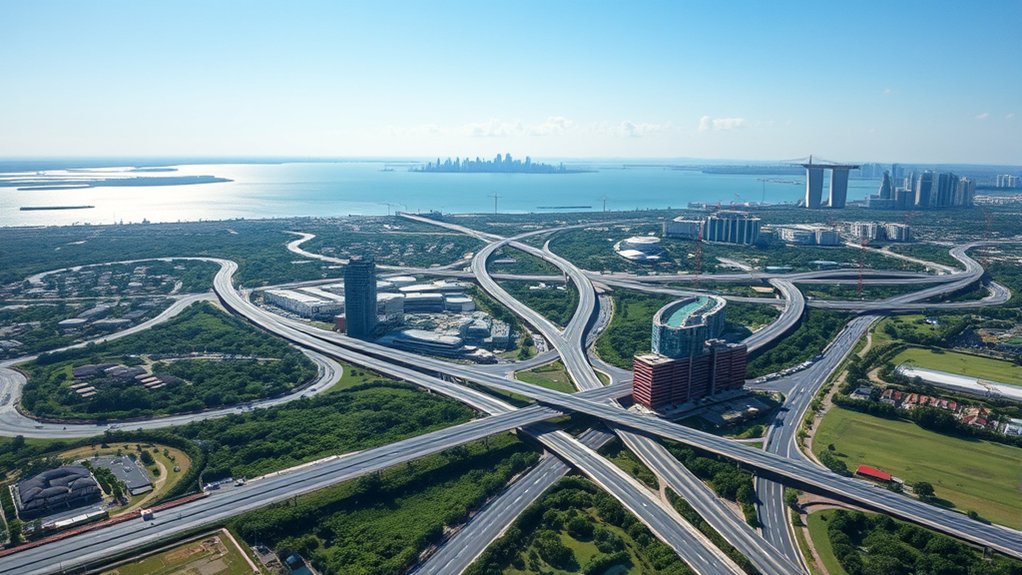
Situated in the Woodlands North area of Singapore, the Woodlands Gateway District is a 35-hectare mixed-use development master-planned by JTC Corporation, designed to serve as Singapore’s northern gateway to the Johor-Singapore Special Economic Zone (JS-SEZ). Roughly the size of 50 football fields, this ambitious project targets its first phase completion around 2030, with subsequent phases rolling out progressively based on business demand.
Connectivity is a major selling point here. The district links directly to Woodlands North MRT station and the upcoming Johor Bahru-Singapore Rapid Transit System (RTS) Link, creating seamless cross-border movement for workers and businesses alike. That integrated transport hub makes the district genuinely practical, not just strategically positioned on a map.
The development blends flexible industrial spaces, office facilities, commercial amenities, and lifestyle offerings into one cohesive district. This mixed-use configuration serves a specific purpose: attracting firms that want to separate cost-intensive manufacturing in Johor from premium R&D, sales, and innovation functions in Singapore. Think of it as a twinning model, where companies get the best of both worlds without choosing one over the other.
Target industries include precision optics and advanced manufacturing, sectors that naturally benefit from this cross-border split. A company could handle component manufacturing and global supply chain coordination in Johor, while maintaining its regional headquarters and innovation teams in Singapore. It is a practical arrangement that keeps costs manageable while preserving access to Singapore’s premium capabilities and international markets. A real-world example of this model in action is Edmund Optics, which uses the Woodlands North Coast for sales, innovation, and R&D while its Johor facility handles component manufacturing.
The broader economic context adds weight to this initiative. ASEAN is projected to become the world’s fourth largest economic bloc by 2030, and the JS-SEZ positions Singapore and Malaysia to capture a meaningful share of that growth. The Woodlands Gateway District fits within Singapore’s wider internationalisation strategy, supporting local enterprises looking to expand regionally, alongside developments in Batam, Bintan, and Karimun. Families and professionals relocating to support this cross-border economy may find the nearby District 27 executive condominiums an accessible and well-connected housing option, given the area’s proximity to Woodlands Regional Centre and established amenities. To further support seamless cross-border living and working, the government is exploring a digital nomad pass modelled in part on Malaysia’s existing framework.
Ultimately, JTC’s vision is to make Singapore the command center for cross-border manufacturing ecosystems, creating jobs on both sides of the causeway while deepening integration into global value chains. The district is still in early planning stages as of March 2026, but its strategic intent is already clear.



One thought on “Budget 2026: JTC to Build Woodlands Gateway District for Cross-Border Johor-Singapore SEZ”