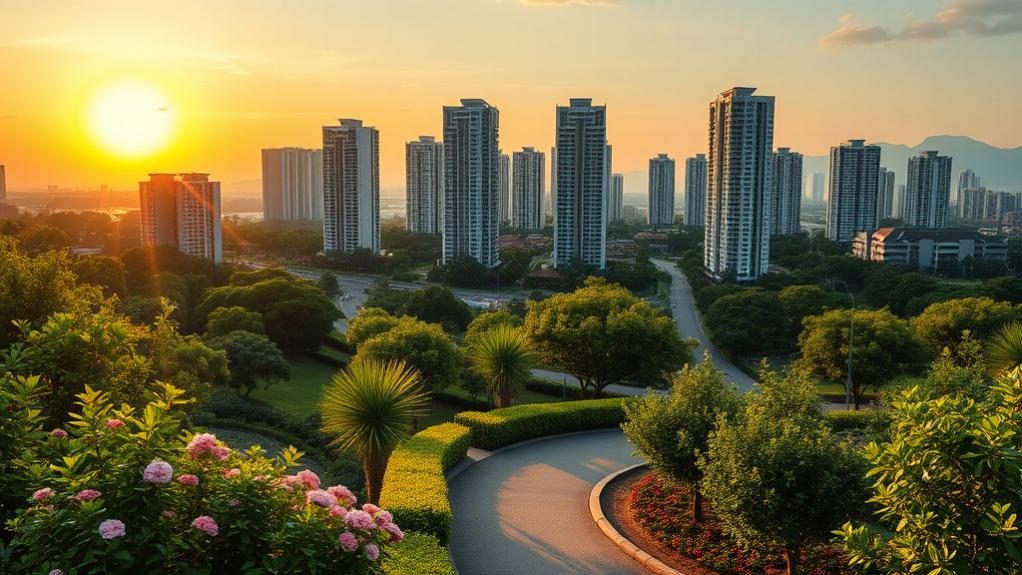
Imagine, for a moment, how Singapore’s northern region could evolve from a quiet outskirts area into a bustling gateway to the world—well, that’s exactly the ambitious vision driving its transformation. The Urban Redevelopment Authority (URA) is spearheading plans to position the North as a vibrant economic hub, focusing on advanced manufacturing, logistics, and high-value industries.
New employment nodes will anchor growth, while decentralizing activities from the central core, which could mean more jobs closer to home for residents—talk about a win-win.
Decentralizing jobs from the central core means more opportunities right at residents’ doorsteps—talk about a true win-win!
Connectivity gets a major boost too, with upgrades to MRT and LRT lines, plus major roadways, making travel smoother. Transit-oriented hubs will link business parks to homes and recreation spots, cutting down commute times profoundly. The Johor-Singapore Rapid Transit System (RTS) link, expected by 2026, will further enhance cross-border connectivity and trade.
Digital infrastructure investments promise smart environments for businesses, and alignments with cross-border projects will enhance trade and mobility, turning the North into a seamless entry point for global commerce.
Urban living in the North emphasizes work-live-play-learn setups, blending jobs, homes, and fun in towns like Woodlands and Sembawang.
New parks, wellness spots, and community areas will sprout up, alongside mixed-use housing that’s family-friendly and inclusive. The former Kranji Racecourse site is poised to become a residential estate with up to 14,000 homes, complete with new amenities.
Public engagement, through exhibitions and tours, ensures locals have a say, fostering a sense of belonging in these evolving neighborhoods.
Sustainability isn’t overlooked; the Kranji Nature Corridor will expand, connecting green spaces like Mandai Mangrove and Central Catchment Reserve to preserve biodiversity.
Policies prioritize climate resilience and eco-friendly designs, with trails and waterfronts encouraging outdoor lifestyles—imagine weekend hikes amid urban buzz, without harming the environment.
Heritage plays a key role, conserving sites in Woodlands and Sembawang while creating identity nodes that celebrate local culture through trails, events, and street art.
This mix of old and new architecture builds district character, sparking community pride.
Finally, innovation shines with underground space development for utilities and logistics, freeing surface land for greener uses.
Subterranean parks and transit could redefine urban planning in land-scarce Singapore, positioning the North as a forward-thinking model.
These plans, if realized, promise a dynamic, sustainable future that’s both practical and exciting.
As with Singapore’s CBD office rental market showing tight vacancy rates of around 5%, new commercial developments in the North are expected to attract businesses looking for expanded spaces at potentially competitive rates.