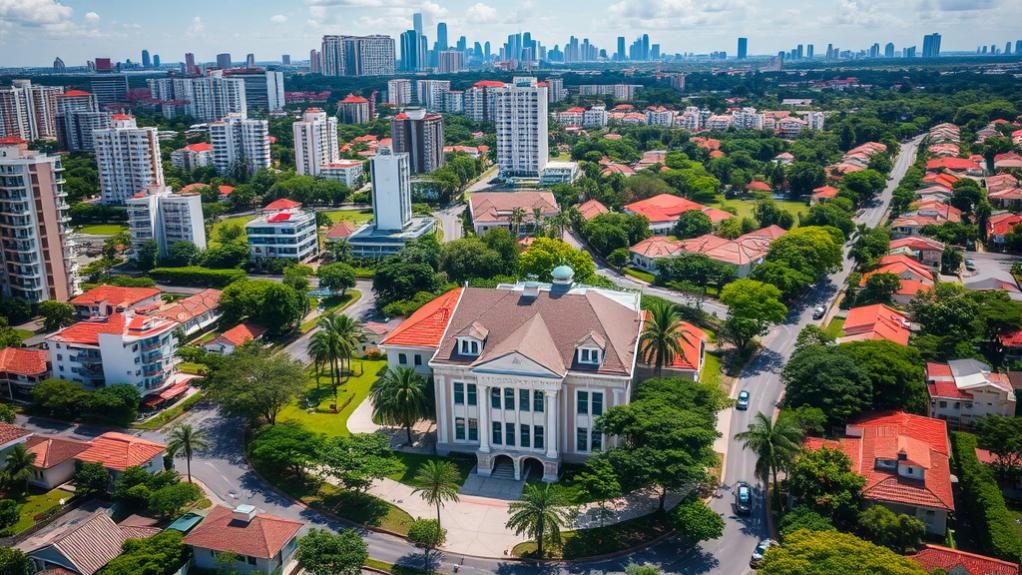
For families planning a move before Primary 1 registration, “within 1km” can quickly become a property-search filter. But living within 1km does not automatically secure a place. Home-school distance is a priority mechanism used when applications exceed vacancies, and it operates together with the registration phase and the child’s citizenship.
An address may improve a child’s priority in an oversubscribed phase, but it does not reserve a place, remove the risk of balloting or guarantee an investment return. Buyers should understand the framework before deciding what school proximity is worth.
What Singapore’s 1km school rule actually does
The Primary 1 exercise is conducted in phases, each with its own eligibility rules. Distance does not move a child into an earlier phase for which the child is not eligible. Instead, if a school is oversubscribed within a phase, the Ministry of Education (MOE) applies citizenship and Home-School Distance (HSD) priority in this order:
- Singapore Citizens living within 1km;
- Singapore Citizens living between 1km and 2km;
- Singapore Citizens living outside 2km;
- Permanent Residents living within 1km;
- Permanent Residents living between 1km and 2km; and
- Permanent Residents living outside 2km.
The full sequence on MOE’s distance-priority page clears up a common misconception: citizenship comes before distance across the two citizenship groups. A Singapore Citizen outside 2km is considered before a Permanent Resident within 1km in the same oversubscribed phase.
Living within 1km is therefore the strongest HSD category for a Singapore Citizen, not an admission guarantee. Families may register for a school more than 2km away, but receive the corresponding lower distance priority if competition exceeds vacancies.
When balloting is needed—and what proximity cannot guarantee
MOE conducts centralised computerised balloting when applicants outnumber vacancies in a phase, from Phase 2A to Phase 2C Supplementary. Higher-priority groups are admitted first. If places cannot accommodate the next priority group, that group ballots with an equal chance; lower-priority groups are unsuccessful.
If all Singapore Citizen applicants within 1km can be accommodated but there are too few places for those between 1km and 2km, only the latter group ballots. If the first group cannot be accommodated, it ballots. The outcome depends on vacancies and the applicant mix, not distance alone.
MOE’s balloting guide also explains how places are reserved for later phases. Review recent vacancy and balloting records, but treat past results as context rather than a forecast. Demand and available places can change.
How MOE and OneMap determine the distance category
The official HSD is not a walking route, driving distance or estimate from a property portal. MOE states that it is the shortest distance from any point on the school boundary to the registrant’s official residential address, based on the residential building outline. The building outline comes from the building plan submitted by the development’s Qualified Person.
This means two nearby blocks—or even different residential buildings within a large development—should not be assumed to share a category. A marketing claim that a project is “within 1km” is not enough. Enter the exact address or postal code in the Singapore Land Authority’s OneMap School Query service.
MOE advises parents to check again in the year of their child’s registration exercise because an HSD category can change when building plans or school boundaries are updated. For an uncompleted project, the official information needed for the building outline may also affect when a reliable result is available. A buyer near the 1km or 2km threshold should seek confirmation rather than relying on a sales brochure, an agent’s map or a straight-line measurement.
The address used must be genuine—and the 30-month rule matters
Ordinarily, the registration address should be the parents’ official residential address shown on their NRICs. If a child obtains priority admission through the HSD category, the child must live at that address, which must remain the registering parent’s NRIC address, for at least 30 months from the start of the relevant P1 Registration Exercise. MOE says the family is expected to remain there for the child’s primary-school years, while recognising that some families cannot do so for the full period.
There are specific arrangements for a property being purchased. A yet-to-be-completed new property may be used if its vacant or delivery possession date—not a probable completion date—is within two years of the child entering P1 and the required documents and undertaking are supplied. If HSD priority secures the place, the 30 months begin when the family moves in. For a resale property currently being purchased, the parent must undertake to live there from the start of the child’s P1 school term and provide the prescribed purchase documents; the 30 months begin from that school term.
A caregiver’s address is not a shortcut into the within-1km category. Subject to MOE’s declaration and approval process, it may be used where both parents work full-time and the child is cared for by a grandparent or a parent’s sibling. Even when that caregiver lives within 1km, the child is grouped with applicants of the same citizenship living between 1km and 2km. The same childcare arrangement at the same address must continue for at least 30 months if it successfully provides priority admission.
These conditions and documentary requirements can change, so parents should read MOE’s current P1 registration address rules before committing to a transaction. MOE conducts checks. False information may be referred to the police, while abuse of the system or failure to satisfy the stay requirement can result in the child being transferred to another school chosen at MOE’s discretion.
What school proximity means for a property purchase
A home near several primary schools can have genuine practical value: shorter daily journeys, easier childcare logistics and more school choices within the nearer distance bands. It may also appeal to a broader pool of family buyers later. Our broader guide to school proximity and family home-buying decisions examines those considerations without treating admission or resale gains as certain.
The risk is allowing one hoped-for school place to dominate the purchase. A household could pay a large premium, still face a ballot, and later discover that the home performs poorly on commute, layout, noise, affordability or resale appeal. School demand can change, and schools can relocate, merge or alter their boundaries. The value of the property should therefore make sense even if the preferred admission outcome does not happen.
For owner-occupiers, a useful approach is to separate “family-use value” from expected financial return. A shorter school run may be worth paying for because it improves daily life, but that is different from assuming the premium will be recovered on sale. Investors without a school-going child should be especially careful not to price in an unverified “1km premium”.
A due-diligence checklist before paying for proximity
- Check the exact unit address. Use OneMap School Query, not the project name or show-flat location, and save the result for your records.
- Verify it in the registration year. Treat today’s category as planning information, especially for a future registration or an uncompleted project.
- Study the relevant phase. Confirm the child’s phase eligibility and review recent vacancies and balloting outcomes for more than one nearby school.
- Model a failed ballot. Identify realistic alternatives and calculate the transport and childcare implications if the first choice is unavailable.
- Match the purchase timeline to MOE rules. Check possession dates, resale completion, NRIC updates, required documents and whether the household can genuinely satisfy the applicable 30-month period.
- Compare like-for-like homes. Examine recent transactions inside and outside the distance band, while controlling for age, tenure, size, floor, condition and transport access.
- Test the whole property. Review financing, stamp duty, lease, title, physical condition, surrounding plans and exit constraints. This Singapore property due-diligence guide provides a wider pre-purchase checklist.
- Put key claims in writing. Ask MOE or SLA about unresolved policy or mapping questions; do not rely on verbal assurances from a seller or salesperson.
The 1km category can be a meaningful advantage where a school is oversubscribed, but it is only one part of P1 allocation and one factor in buying a home. The sound purchase is an address the family can lawfully use, comfortably hold and happily live in—even if the ballot does not go its way.


One thought on “Singapore’s Primary 1 Distance Rule: A Homebuyer’s Guide”