Singapore’s commercial office sector began the year on solid footing, with prime Grade A office rents in the Central Business District holding resilient at an average of SGD 11.67 per square foot per month during the first quarter. This performance reflects a modest 0.5 percent quarter-on-quarter increase, maintaining the steady, measured trajectory observed throughout the previous year. The data highlights the underlying durability of Singapore’s commercial core amid broader global macroeconomic shifts.
Demand for top-tier office premises continues to be anchored by multinational corporations, international wealth management institutions, legal firms, and artificial intelligence technology companies establishing their Asia-Pacific regional headquarters in Singapore. Despite global cost containment measures in several industries, the flight-to-quality trend remains the dominant operational dynamic across the downtown office landscape.
Grade A Rental Stability in Raffles Place and Marina Bay
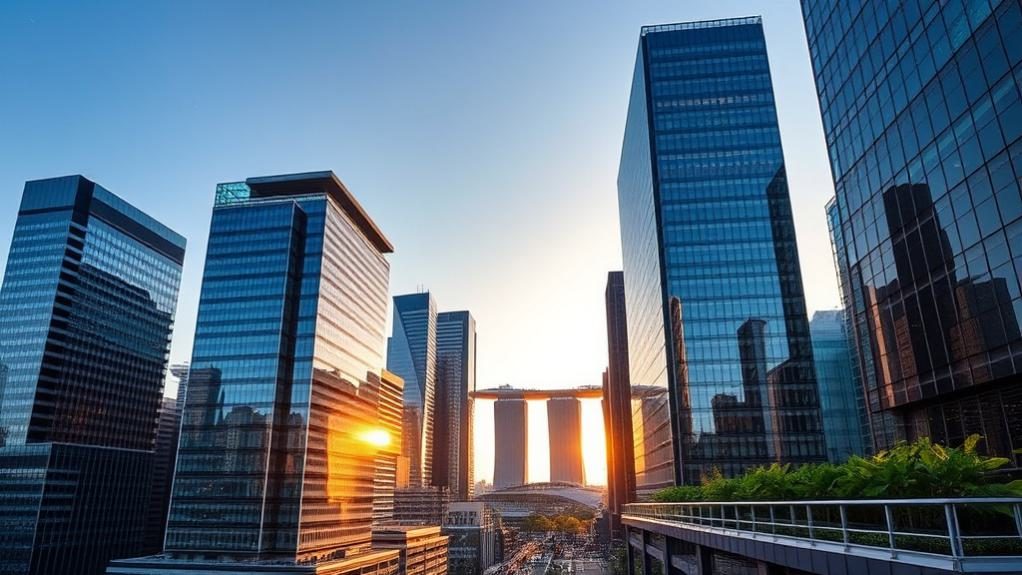
The rental resilience is most pronounced in core micro-markets such as Marina Bay and traditional Raffles Place. Prime assets in these locations continue to command premium monthly rentals, with premier landmark towers achieving rates between $12.50 and $14.00 per square foot for high-floor units offering panoramic sea and city views.
Tenants operating in financial services, asset management, and private banking prioritize prestigious addresses that facilitate client engagement and support corporate branding. Concurrently, secondary commercial sub-markets like Shenton Way, Tanjong Pagar, and City Hall registered stable rental rates ranging from $10.20 to $11.40 per square foot, providing viable options for businesses seeking well-connected office space with competitive leasing packages.
Flight-to-quality patterns also reflect evolving workplace attendance norms. While flexible hybrid working arrangements remain common across multinational organizations, financial and legal institutions increasingly mandate regular office attendance, reinforcing the need for well-located commercial hubs that reduce transit friction for professional staff.
These corporate leasing dynamics are explored further in our report on how AI technology firms and multinational expansion drive CBD Grade A office space demand, underscoring the specific space requirements of high-growth tenants.
Corporate Flight to Quality and Shadow Space Absorption
The defining trend in the current leasing cycle is corporate flight to quality. Organizations are actively rightsizing their physical footprints while upgrading to newer, more efficient office towers that offer superior technological infrastructure, flexible floorplates, and modern employee wellness amenities.
This structural shift has assisted in the orderly absorption of shadow space—office premises surrendered early by restructuring technology firms and multinational banks. Rather than triggering widespread vacancy increases, secondary lease availability was systematically absorbed by expanding professional services firms, sovereign wealth funds, and newly established family offices.
As documented in our review of tight prime office supply supporting commercial rents across Singapore, limited new development completions have prevented the structural oversupply issues observed in other international gateway cities.
Supply Constrained Prime Pipeline and Vacancy Benchmarks
The fundamental driver behind Singapore’s office rental resilience is a tightly constrained future supply pipeline. The Urban Redevelopment Authority’s master planning framework has carefully balanced commercial land releases against residential and infrastructure needs, ensuring that no sudden deluge of prime office space floods the market. Unlike competing financial hubs that experienced rapid commercial overbuilding, Singapore’s controlled commercial land pipeline has protected downtown occupancy levels across multiple economic cycles.
Quarterly commercial real estate statistics and tenancy updates published by the Urban Redevelopment Authority confirm that island-wide office vacancy rates in the central area hover around 5 to 6 percent, a level that reflects healthy market equilibrium and leaves landlords in a firm negotiating posture.
Macroeconomic guidance and financial sector resilience indicators issued by the Monetary Authority of Singapore highlight Singapore’s role as a trusted financial hub, providing ongoing stability to international corporate tenants making long-term capital commitments. Institutional investors continue to view Singapore prime commercial property as an essential defensive allocation within balanced global portfolios.
Green Mark Certification and Multinational Tenant Priorities
Environmental sustainability has transitioned from a corporate aspiration to a non-negotiable leasing mandate for top-tier occupiers. Multinational corporations, particularly European and American firms, operate under strict global ESG compliance frameworks requiring them to lease space in certified green buildings.
Regulatory frameworks and environmental sustainability standards overseen by the Building and Construction Authority, including the BCA Green Mark Platinum and Super Low Energy ratings, heavily influence leasing decisions. Buildings equipped with advanced energy-efficient air distribution systems, smart lighting, and water conservation technologies enjoy higher occupancy rates and superior rental retention rates compared to aging, uncertified commercial stock.
Landlords of older commercial buildings are actively investing in retrofitting programmes and asset enhancement initiatives to secure green accreditations and prevent tenant departures toward newly certified developments.
Beyond energy metrics, wellness features such as biophilic design, dedicated bicycle parking facilities, and high-efficiency particulate air filtration are becoming standard tenant expectations during major lease renewal negotiations.
Outlook for Commercial Office Tenants and Landlords
Looking ahead across the remainder of the year, Singapore’s Grade A office rental market is expected to maintain its steady course, with annual rental growth projected in the low single digits of 1 to 3 percent. The limited volume of upcoming new completions in 2026 and 2027 will provide a protective floor under rental rates, shielding commercial landlords from sharp downside risks.
For corporate tenants, advance lease renewal planning and strategic workplace design will be critical in managing real estate expenditure. Many organizations are adopting core-and-flex occupancy models, pairing a fixed core lease in prime towers with flexible co-working spaces to accommodate headcount variations without committing to excess square footage.
For commercial asset owners, continued investment in building sustainability, digital infrastructure, and tenant experience will determine which properties successfully command top-tier rental premiums in Singapore’s competitive commercial landscape.