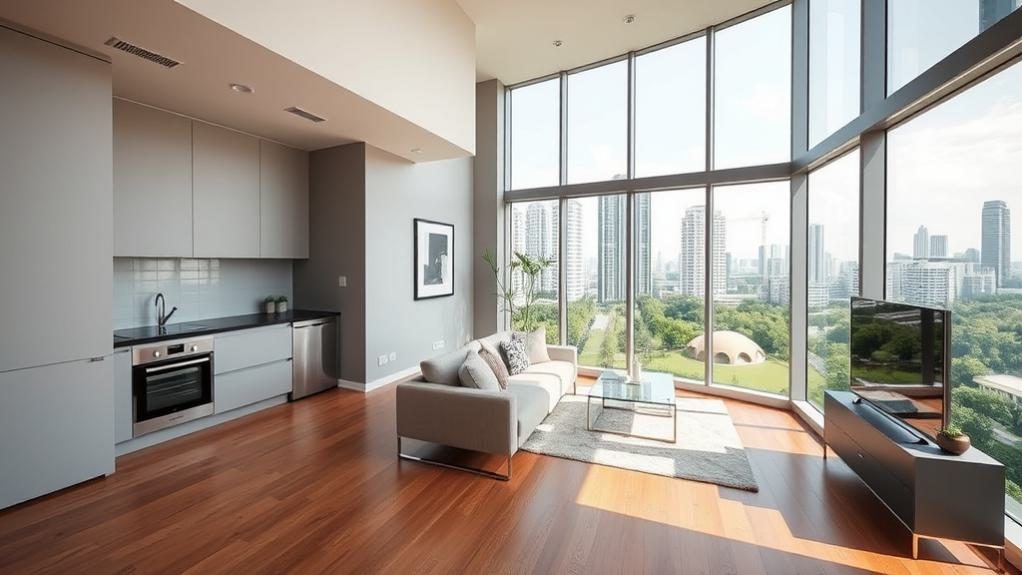
A new 400 sq ft condo can be a workable home or investment, but its lower total price does not automatically make it good value. In a compact unit, every design compromise matters: an inefficient entrance, oversized balcony or poorly placed structural column can remove a meaningful share of the usable living space.
The decision should therefore begin with the unit itself, not a forecast about whether Singapore property prices will rise. Buyers need to test the floor plan, total ownership cost, project fundamentals and likely resale audience before paying a booking fee.
Start with usable space, not the advertised number
About 400 sq ft is roughly 37 sq m, but that headline figure does not tell you how comfortably the unit will function. Read the unit floor plan and ask the sales team to identify what is included in the strata area. Bay windows, balconies, private enclosed spaces, air-conditioner ledges and wall thickness can affect how much space feels usable, depending on the project and approved plans.
Measure the clear dimensions of the bedroom, living area and kitchen rather than judging the dressed show unit. Check whether a standard bed leaves room to open the wardrobe, whether the dining position blocks circulation, and where luggage, cleaning equipment and laundry will go. Confirm ceiling heights, window sizes, ventilation, door swings and the location of columns and service risers.
A show flat may use customised furniture, mirrors or removed walls to create a sense of openness. Compare it with the actual unit plan and specifications. URA’s official home-buying guidance says developers must provide mandatory project and unit information before taking a booking fee, and that show-flat plans, models and units must accord with approved building plans. Keep copies of the plan, specifications and marketing material on which your decision relies.
Test the layout against real life
A compact condo should be assessed for the way it will be used over several years. An owner-occupier working from home may need a proper desk, acoustic separation and storage more than a large balcony. A couple should test whether two people can cook, dress and move around without repeatedly converting furniture. Buyers planning for children, frequent guests or an elderly parent should be candid about how soon the home could become too small.
Visit the site at different times. Note road and rail noise, afternoon sun, nearby construction, refuse areas, loading bays and the route from the unit to public transport and groceries. Stack choice can materially change light, privacy and heat even when two units share the same floor plan. Check the approved site plan rather than assuming an unblocked view or vacant neighbouring plot will remain unchanged.
Also compare the unit with slightly larger resale homes nearby. A new launch may have newer facilities and a staged payment schedule, while an existing unit can be physically inspected and may provide more internal area for the same budget. The relevant choice is not simply “small condo or nothing”; it may include renting longer, buying resale or choosing a different location. Our Singapore property due-diligence guide sets out broader checks on title, tenure, surroundings and physical condition.
Calculate the full cost, not just the monthly mortgage
Build an all-in budget covering the purchase price, Buyer’s Stamp Duty, any Additional Buyer’s Stamp Duty, legal fees, valuation charges, loan-related costs, renovation, furnishings, insurance, maintenance contributions and property tax. New units can still require substantial spending on lighting, curtains, storage and appliances. If completion is years away, include rent or the cost of carrying another home during the wait.
ABSD depends on the buyer’s profile, residency status and residential-property count. BSD and ABSD are generally computed on the higher of the purchase price or market value. Check the current position directly with IRAS before committing, because tax treatment can change and joint purchasers may face the highest applicable profile.
Obtain an in-principle assessment from a bank before paying a booking fee, but do not treat the maximum loan as a safe budget. MAS requires financial institutions to apply the Total Debt Servicing Ratio framework to property-purchase loans. Its TDSR explanation shows how monthly debt obligations and gross income are assessed. Stress-test the mortgage at a higher interest rate, on one income where relevant, and with several months of vacancy if the unit is intended for rent.
Compare prices on a like-for-like basis
Do not rely only on the project’s average price per square foot or an advertised “from” price. Compare the exact unit with recent transactions for similar sizes, tenure, age, floor level and location. Small units can command a higher price per square foot because the total quantum is lower; that does not guarantee stronger appreciation.
URA’s private residential transaction search covers new-sale options and resale or subsale caveats from the last 60 months. Caveat data are useful but not exhaustive, because caveat lodgement is not mandatory. Look at several transactions rather than selecting one unusually high or low deal.
For an uncompleted project, compare the premium over nearby completed condos and ask what justifies it. Then examine the project’s tenure, expected completion, unit mix, number of lifts, parking provision, maintenance budget and density of competing small units. A low entry quantum can be offset by high recurring costs or a large future supply of similar apartments.
Be realistic about rent and resale demand
If the purchase depends on rental income, identify the actual tenant pool. Proximity to an MRT station helps, but tenants also weigh commute time, groceries, noise, furnishing, building condition and competing supply. Use recent rental contracts for comparable unit sizes and deduct maintenance, property tax, agent fees, repairs, vacancy and mortgage interest before estimating a net return. The separate guide on assessing a condo for rental provides a fuller framework.
Resale liquidity matters even to owner-occupiers. Ask who is likely to buy a 400 sq ft unit from you: a single owner, a couple or an investor? A layout that works only with bespoke furniture may narrow that pool. Review the number of comparable one-bedroom units within the project and nearby, and consider whether future launches could offer newer alternatives at a similar total price.
A short planned holding period is especially risky. Transaction costs are front-loaded, market conditions can change, and Seller’s Stamp Duty may apply when a residential property is sold within the applicable holding period. Verify the current rules before assuming an easy exit.
A practical decision rule
A new 400 sq ft condo is more defensible when the layout is genuinely efficient, the location serves a clear daily or tenant need, the price is supported by comparable transactions, and the buyer can carry all costs without optimistic rent or capital-growth assumptions. It is less convincing when the case rests on launch-day discounts, a future view, a headline price per square foot or the belief that any small unit will be easy to rent.
Before signing, have a conveyancing lawyer review the Option to Purchase and Sale and Purchase Agreement, confirm financing and CPF limits, and retain enough cash for taxes, completion payments and unexpected costs. The best small condo is not necessarily the cheapest entry into private property; it is one whose space, finances and exit options still work under conservative assumptions.