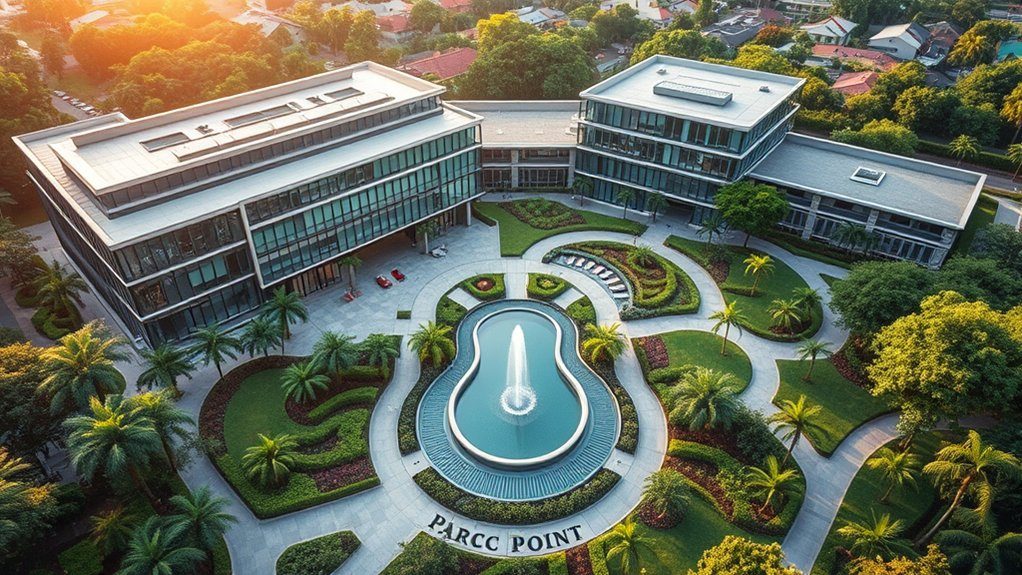
As residents progressively collect their keys and settle into Singapore’s newest eco-friendly smart town, commercial and social infrastructure is taking concrete shape along Tengah Park Avenue. Following the opening of Plantation Plaza in mid-2024, Tengah Parc Point serves as the town’s second commercial and community anchor. Designed to meet the everyday needs of early residents in the Park District, the development integrates essential retail, dining, childcare, and healthcare services within walking distance of nearby residential precincts planned by the Housing & Development Board.
The Role of Parc Point in Tengah’s Five Planned Districts
Tengah is master-planned across five distinct housing districts: Plantation, Garden, Park, Brickland, and Forest Hill. Each district is conceived with a unique thematic character while functioning as an interconnected part of a car-lite, forest-themed town spanning 700 hectares. Parc Point is positioned in the Park District, providing a dedicated commercial focal point for surrounding housing developments including Parc Residences @ Tengah, Parc Glen, and adjacent residential parcels.
In early township development, the sequenced delivery of amenities is essential to resident welfare. When pioneering homeowners moved into Tengah in late 2023, access to grocery stores, eateries, and basic services required traveling to neighboring estates like Bukit Batok or Jurong West. The launch of Plantation Plaza provided the initial commercial relief in the south. The completion and operation of Parc Point adds critical commercial capacity in the central zone, ensuring that thousands of additional households have immediate retail options without waiting for the town’s larger regional commercial center, Tengah Mall, scheduled for later phases of town development.
This phased rollout highlights the careful alignment between residential handover dates and public infrastructure deployment. HDB works closely with government agencies to coordinate utility networks, pedestrian pathways, and commercial tenancies before large residential clusters reach high occupancy levels, mitigating early transition difficulties often faced in nascent housing precincts.
Integrated Amenities: Daily Retail, Supermarket, and Polyclinic Services
Parc Point is structured around a diverse tenant mix curated to handle daily domestic routines. The complex features a full-service supermarket, food court, bakeries, hair salons, enrichment centers, and convenience retail. By grouping these essential services under one roof, HDB ensures that residents can purchase groceries, dine, and handle banking or personal errands within a short stroll from their apartment lift lobbies.
A central pillar of the development is the inclusion of dedicated healthcare infrastructure. The complex houses the future Tengah Polyclinic, operated by the National University Health System. Having an integrated polyclinic within the neighbourhood hub provides outpatient medical care, maternal and child healthcare, dental treatment, and chronic disease management directly to the local community. This integration reduces hospital congestion in the western region and ensures elderly residents and families with young children have direct access to subsidized public healthcare without travelling to established medical centres in Jurong or Bukit Batok.
Transport Integration: Tengah Bus Interchange and Jurong Region Line
Seamless public transit connectivity is foundational to Tengah’s design as Singapore’s first car-free town centre. Parc Point is situated adjacent to dedicated transit corridors and is connected to the Tengah Bus Interchange, which commenced operations in July 2024. Feeder bus services connect the hub directly to surrounding residential blocks and neighboring transport interchanges at Bukit Batok, Jurong East, and Boon Lay, ensuring reliable daily commuting options.
Rail connectivity will undergo a significant leap forward with the completion of the Jurong Region Line, developed by the Land Transport Authority. The nearby Tengah Park MRT station (station code JE2) will serve the Park District, providing direct rail transit across the western industrial hubs, Nanyang Technological University, and the Jurong Lake District. Comprehensive walking and cycling paths encircle Parc Point, enabling residents to travel safely on foot or via personal mobility devices without navigating vehicular road crossings.
HDB’s New Generation Neighbourhood Centre Model in Smart Towns
Parc Point exemplifies HDB’s New Generation Neighbourhood Centre concept. Unlike older commercial hubs from past decades that focused primarily on static shopfronts, modern NGNCs are planned as multi-functional community living rooms. The architecture incorporates sheltered community plazas, open-air landscaped terraces, rainwater retention gardens, and naturally ventilated public seating areas where residents can gather for grassroots activities and neighborhood events.
The design also incorporates smart environmental technologies, including automated waste collection systems, energy-efficient lighting, and rooftop solar photovoltaic arrays. These sustainable features align with Singapore’s broader urban development vision under the statutory master plan guided by the Urban Redevelopment Authority, demonstrating how public housing estates balance dense living with ecological stewardship.
These commercial facilities are also closely tied to broader price dynamics across public and private residential sectors. As shown in our market research on whether Singapore’s HDB and private property markets are separating, self-contained estate planning is a cornerstone in preserving equitable housing standards across greenfield towns.
Township Maturity and Living Considerations for Early Tengah Homeowners
For current and prospective residents, the progressive delivery of amenities at Parc Point marks an important transition toward township maturity. Early buyers in new towns frequently endure construction noise, dusty roads, and temporary transport routes while surrounding parcels undergo construction. The establishment of stable commercial anchors transforms an active construction zone into an authentic community where daily life functions smoothly.
From a property valuation perspective, the completion of retail hubs and transport links historically provides solid price support for public housing resale values once initial MOP periods expire. Homeowners assessing their long-term housing trajectory often monitor how neighborhood infrastructure influences demand, a dynamic analyzed in our discussion on why housing demand patterns evolve across mature and non-mature estates. As Tengah continues its build-out through 2027 and beyond, hubs like Parc Point provide the social and functional framework that anchors residential stability.