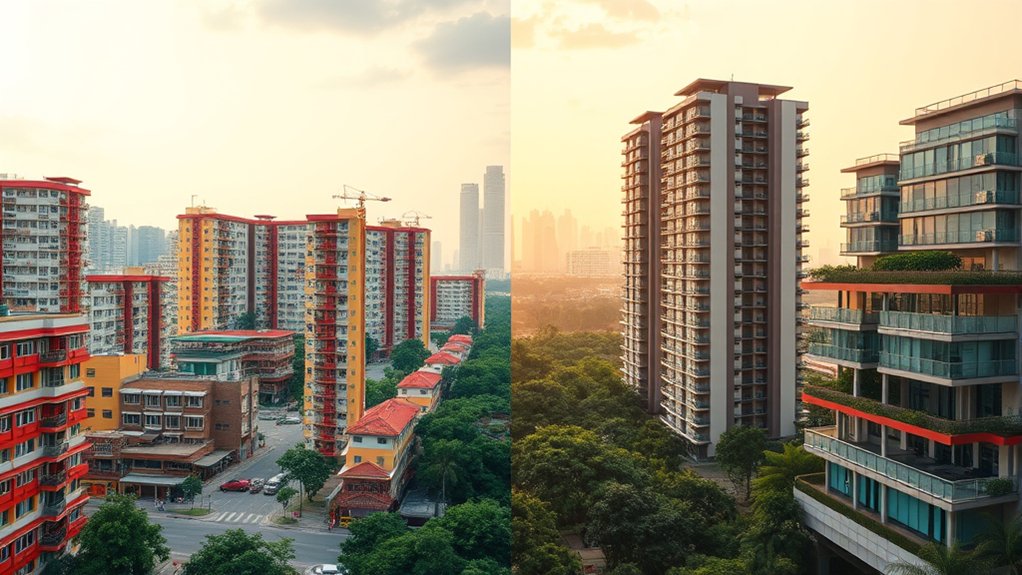
Discussions regarding whether Singapore’s public and private residential property markets are structurally decoupling have become frequent among industry analysts and prospective homebuyers. As private condominium launch benchmarks push into record territory while public housing resale price growth shows signs of stabilization, market observers point to widening price ratios between the two segments. But whether this trend reflects a permanent structural separation or a temporary cyclical divergence requires careful examination of underlying transaction data and buyer behavior.
Historically, the Housing and Development Board (HDB) resale market and the private residential sector moved in synchronized patterns. Upgraders selling their flats provided the capital foundation that fueled mass-market suburban condominium demand, while private property owners downsizing into public housing supported resale prices in mature estates. Analyzing how these linkages operate today clarifies what current market movements mean for homeowners planning their next move.
Diverging price trajectories across public and private segments
Official quarterly indices published by the Urban Redevelopment Authority and HDB illustrate the divergence in headline momentum. While private residential property prices continued their gradual upward trajectory, supported by landed properties and city-fringe transactions, the HDB resale price index moderated its pace of expansion, registering minor quarterly corrections in selected suburban towns.
This divergence is particularly evident when comparing new private launch pricing against prevailing HDB resale valuations. suburban Outside Central Region (OCR) private condominiums regularly launch at average benchmarks between S$2,100 and S$2,400 per square foot, with city-fringe Rest of Central Region (RCR) launches frequently commanding S$2,600 to S$2,900 per square foot. By contrast, mass-market suburban four-room and five-room resale flats trade at average levels of S$550 to S$700 per square foot.
As explored in our detailed breakdown of a decade of rising GLS land prices and condo cost floors, private developers face elevated breakeven costs driven by land tender benchmarks, financing costs, and construction expenses. Because developers cannot lower launch prices below their construction and land baselines without incurring severe losses, new private homes establish high price floors that widen the nominal gap with public housing.
Different buyer profiles drive market separation
The perceived decoupling between public and private sectors is primarily driven by the separation of their respective buyer profiles. The private residential market has increasingly become an owner-occupier domain dominated by affluent multi-generational families, high-income dual-earner households, and buyers with substantial liquid capital.
In the Core Central Region and high-end landed segments, buyers frequently deploy considerable family wealth or rely on existing asset portfolios. These purchasers are less sensitive to incremental shifts in commercial mortgage interest rates or macroeconomic fluctuations. Consequently, premium private home pricing can remain resilient even during periods of broader economic uncertainty.
Conversely, the HDB resale market serves broad-based middle-income Singaporeans who are acutely sensitive to cost-of-living changes, wage growth, and borrowing costs. When commercial mortgage rates fluctuate, HDB buyers must balance their repayments against statutory caps. As outlined in our analysis of HDB resale market contractions and upgrader considerations, the buyer pool for standard public flats simply lacks the balance sheet flexibility to absorb rapid price increases indefinitely.
Scrapping the 15-month wait-out rule and downgrader flows
Policy adjustments have also played a significant role in recalibrating buyer flows between private and public sectors. In September 2022, authorities introduced a temporary 15-month wait-out period requiring private residential owners to wait 15 months after selling their private property before buying a non-subsidized HDB resale flat, aimed at curbing price pressure on larger resale flats.
That restriction has since been removed, restoring greater liquidity to the market and allowing older private homeowners to downsize into the public resale market without forced renting periods. The removal of the wait-out rule helped normalize transaction flows, enabling older households to unlock home equity from private assets while providing steady demand for premium resale flats in mature towns.
For homeowners evaluating how changes to downgrading rules affect their selling and buying timelines, this guide on the removal of the 15-month wait-out period for private property owners provides a clear explanation of how the policy change operates in practice.
Upgrader math and the widening condo cash downpayment
The practical implication of diverging price levels falls squarely on HDB upgraders. In past property cycles, a family selling a five-room flat for S$600,000 could comfortably transition into a new suburban three-bedroom condo priced around S$1.2 million to S$1.4 million. The net sales proceeds and CPF savings from the flat often covered the required 25% downpayment with comfortable reserves left over.
Today, with new suburban three-bedroom private units regularly pricing above S$2.1 million, the financing math is far more demanding. Under the Total Debt Servicing Ratio (TDSR) framework, a buyer borrowing at maximum capacity must still provide a minimum 25% downpayment—equating to over S$525,000—of which at least 5% (over S$105,000) must be paid in liquid cash.
Even if an upgrader flat fetches S$750,000, outstanding mortgage settlements and the mandatory refund of CPF principal plus accrued interest can leave families with insufficient liquid cash to bridge the private purchase. This widening cash barrier has caused many families to pause their private condo upgrading plans, choosing instead to remain in their public flats or explore Executive Condominiums.
Key transaction timing checks for HDB upgraders
Homeowners planning to upgrade from an HDB flat to private property must execute their transactions with disciplined planning to avoid unnecessary financial stress or costly transitional housing.
The primary consideration is managing the transaction timeline. HDB resale completions generally require around eight weeks from the first appointment, whereas private property completions take between ten and twelve weeks. If you buy your private condo before completing the sale of your HDB flat, you will be liable to pay Additional Buyer’s Stamp Duty (ABSD) upfront, though married couples with at least one Singapore citizen spouse can apply for remission if the flat is disposed of within six months.
To avoid taking on short-term ABSD liabilities and stretching cash reserves, many upgraders prefer to sell their HDB flat first, securing an option to purchase on their next property only after the flat sale is legally binding. Structuring an extension of stay with the resale buyer can provide up to three months of rent-free transition time, ensuring a smooth move into your new private residence without financial disruption.


One thought on “Are Singapore’s HDB and Private Housing Markets Decoupling?”