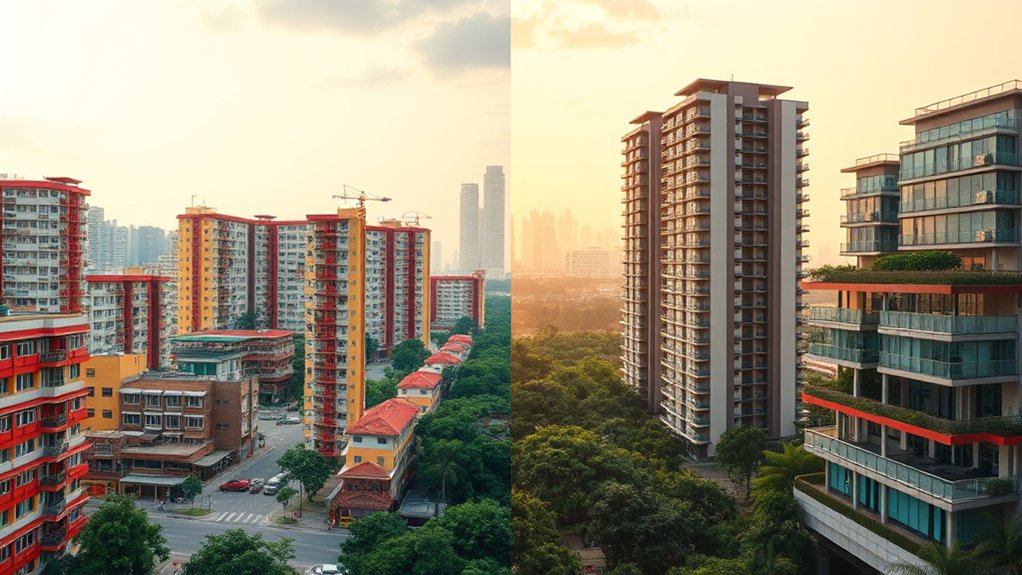
Singapore’s secondary public housing market concluded 2025 on a noticeably steady note, with the Housing and Development Board resale price index posting flat quarterly movement in the final three months. Official flash figures confirm that full-year price expansion for 2025 moderated to 2.9 percent. This marks a sharp deceleration from the 4.9 percent increase registered in 2023 and the 9.7 percent spike recorded in 2024, demonstrating that comprehensive cooling measures and expanding physical housing supply have successfully restrained price escalation.
The stabilization in secondary public flat prices brings welcome predictability to both first-time buyers and families rightsizing their living arrangements. Transaction volumes across estates exhibited healthy liquidity without the speculative price pushes seen in previous cycles. Real estate professionals point out that while headline-grabbing million-dollar transactions still make news in prime precincts, the vast majority of standard flats now transact within tight valuation boundaries aligned with baseline family income growth.
Flat Resale Price Momentum Following Multi-Year Expansion
The flat quarterly price trajectory observed in late 2025 represents the first true pause in quarterly resale price growth in nearly six years. Between early 2020 and late 2024, persistent construction delays caused by global disruptions led to an acute supply-demand imbalance, sending buyers into the resale market and driving values upward across almost every housing estate.
That multi-year growth cycle has now leveled out as construction handovers caught up with historical commitments. Buyers are approaching negotiations with heightened financial scrutiny, comparing resale asking prices directly against new Build-To-Order options. As detailed in our earlier analysis of HDB resale market price trends and upgrader due diligence, households are no longer willing to commit to elevated cash premiums over valuation when market alternatives are readily available.
Transaction records maintained on the Data.gov.sg national repository show that while transaction volumes reached roughly 27,000 units across the full year, median transaction prices remained relatively steady across three-room, four-room, and five-room layouts in suburban districts.
Mature Versus Non-Mature Estate Price Differentials
While the overall national index remained flat, town-level transaction patterns revealed contrasting performance between mature and non-mature estates. Mature neighbourhoods such as Queenstown, Toa Payoh, Bishan, and Bukit Merah recorded marginal price increases between 0.3 percent and 0.8 percent over the closing months. These central towns continue to hold defensive pricing due to consolidated public transit links, proximity to major commercial hubs, and an inherently constrained supply of land for new housing developments.
Conversely, non-mature towns including Punggol, Sengkang, Yishun, and Jurong West saw modest price softening of 0.2 percent to 0.5 percent. A significant factor in these suburban areas is the steady stream of flats completing their five-year Minimum Occupation Period. As hundreds of owners in large BTO precincts gain resale eligibility, competing listings have emerged on the open market, providing purchasers with ample negotiating leverage.
These dynamics are examined further in our coverage of how younger resale flats face growing competition from public housing launches, showing how buyers actively evaluate remaining lease duration and unit finish before committing their CPF funds.
Construction Handover Cadence and the BTO Pipeline
The primary stabilizer in the public housing sector has been the sustained delivery of new homes. The Ministry of National Development and the Housing and Development Board have delivered tens of thousands of completed flats across the island over the past 24 months, clearing pandemic-era backlogs and returning normal wait times to standard BTO developments.
Official policy pronouncements released on the Ministry of National Development portal highlight that the government delivered over 55,000 BTO flats between 2021 and 2025. This decisive addition of physical shelter removed significant pressure from the open resale market, allowing newly formed families to collect their keys rather than turn to secondary flats out of scheduling urgency.
For buyers evaluating prospective neighbourhoods, comprehensive project benchmarks and historical valuation data are accessible directly on the Housing and Development Board website, enabling informed decisions on flat selection and town amenities.
Mortgage Safeguards and the Scrapped Wait-Out Period
Macroprudential policies and targeted regulations have played an indispensable role in moderating price momentum. For public housing purchasers, the 30 percent Mortgage Servicing Ratio cap continues to ensure that buyers do not over-leverage their monthly cash flow. Concurrently, the loan-to-value limit for HDB housing loans remains at 75 percent, requiring purchasers to fund a larger equity component upfront.
In addition, the regulatory environment for private homeowners transitioning into public housing has evolved. In September 2022, authorities introduced a temporary 15-month wait-out period requiring private property owners to wait before purchasing a non-subsidized HDB resale flat. That temporary restriction has since been removed, restoring normal transaction flows for retirees and families downsizing from private property into public flats without disrupting broader market stability.
As documented in Calin Chong’s market advisory explaining how the removal of the 15-month wait-out rule impacts HDB resale buyers, rightsizing households can now purchase secondary flats without having to navigate costly intermediate leasing arrangements.
Furthermore, standard regulations governing the use of Ordinary Account savings managed by the Central Provident Fund Board continue to promote disciplined retirement savings preservation, limiting CPF usage based on remaining lease length relative to the youngest buyer’s age.
What Prospective Buyers and Sellers Face Going Forward
Looking ahead across 2026, market participants should anticipate steady resale activity characterized by modest price growth in the low single digits. With construction pipelines stabilized and new BTO launches offering diverse town locations under the standard classification framework, the pricing leverage previously held by sellers has shifted toward a more balanced equilibrium.
Sellers must adopt realistic asking prices, as prospective buyers are well-equipped with transparent transaction records and will walk away from listings requiring excessive Cash-Over-Valuation. For buyers, the calm market conditions offer a healthy window to assess personal finances, review long-term CPF retirement projections, and negotiate without fear of sudden price jumps.