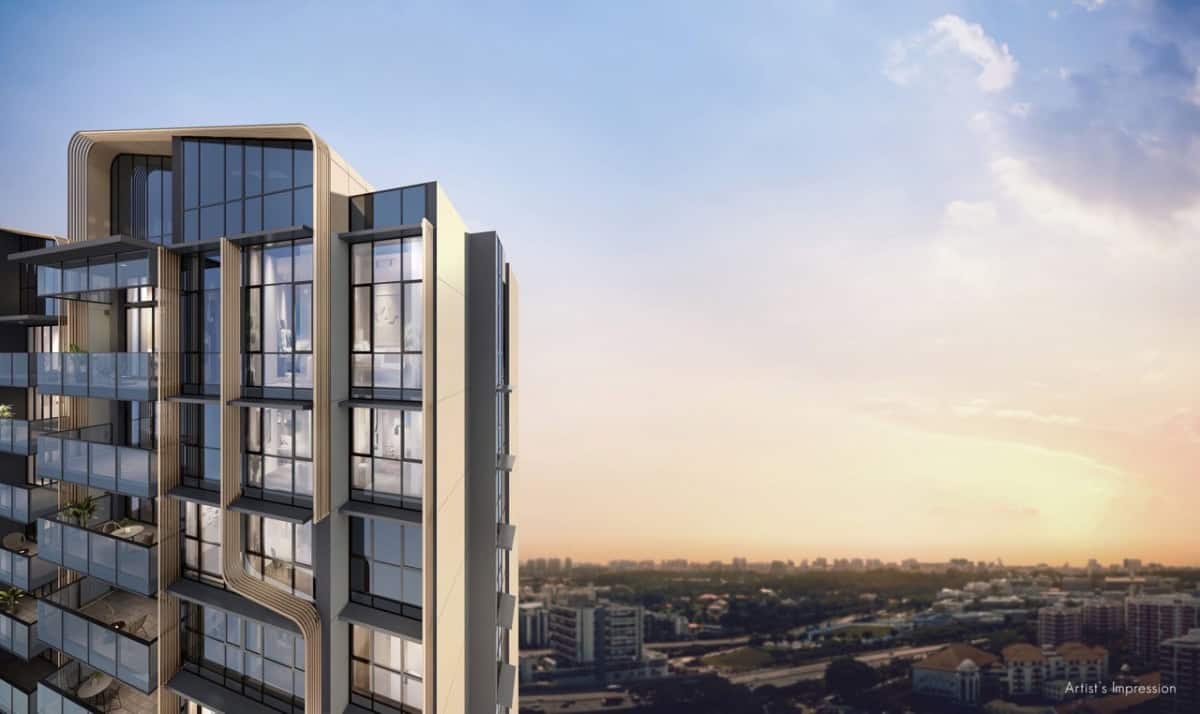
In one of the most striking valuation divergences in modern Singapore real estate history, a new 3-bedroom unit in the Outside Central Region (OCR) / city-fringe boundary now commands a significantly higher dollar quantum than a substantially larger luxury apartment in prime Marina Bay. Recent transactional caveat records reveal that 3-bedroom units at Chuan Park in Serangoon transacted at an average of $3.28 million ($2,704 psf for 1,206 sq ft). Concurrently, 3-bedroom residences at the prestigious Core Central Region (CCR) development Marina Bay Suites changed hands at a median of just $2.90 million ($1,833 psf for 1,582 sq ft).
This dynamic creates an unprecedented spatial arbitrage: buyers at Marina Bay Suites are securing 376 square feet more living area for $375,000 less capital outlay. More remarkably, a 12-month study of secondary resales at Marina Bay Suites reveals that 100% of repeat transactions (all 9 sales) concluded at a severe capital loss, with a median decline of -16%. This comprehensive analysis examines the structural mechanisms driving the Chuan Park vs Marina Bay Suites price dislocation and explores whether prime CBD residential real estate is fundamentally broken or presenting a generational value window.
The $375,000 Spatial Disparity: Examining the Head-to-Head Metrics
A decade ago, the suggestion that a 99-year suburban condominium in District 19 could comfortably outprice an elite high-rise address overlooking Marina Bay Sands would have been dismissed as unthinkable. Today, URA caveat records demonstrate that market fundamentals have pivoted decisively toward domestic owner-occupier livability.
| Key Metric | Chuan Park (Serangoon, D19) | Marina Bay Suites (Downtown, D01) | Arbitrage / Net Variance |
|---|---|---|---|
| Market Segment | OCR / City-Fringe Rest of Central | Core Central Region (CCR Luxury) | Prime Core vs Heartlands |
| Development Status | New Launch (Under Construction) | Completed Resale (TOP 2013) | Fresh 99-Yr Lease vs 13-Yr Old Asset |
| Median 3-Bedder Price | $3,280,000 | $2,900,000 | Chuan Park +$380,000 (+13.1%) |
| Median 3-Bedder Unit Size | 1,206 sq ft | 1,582 sq ft | Marina Bay Suites +376 sq ft (+31.2%) |
| Median Per Square Foot ($PSF) | $2,704 PSF | $1,833 PSF | Chuan Park +$871 PSF (+47.5%) |
| 12-Month Sales Volume | 55 transactions (3-Bedders) | 6 transactions (3-Bedders) | High Liquidity vs Thin Resale Pool |
| Recent Resale Track Record | Pioneer Launch Velocity | 100% Unprofitable (9 of 9 Deals) | Median Seller Loss: -16.0% |
The gap is even more glaring when analyzed on unit rates. At $2,704 psf, buyers at Chuan Park are paying a 47.5% per-square-foot premium over Marina Bay Suites. While a portion of this premium reflects the value of an unexpired 99-year leasehold tenure, brand-new smart facilities, and modern layout efficiencies, the wider structural driver lies in who is actually buying property in Singapore today.
The 100% Loss Phenomenon: Why Marina Bay Suites Repeat Sales Collapsed
While secondary units at Marina Bay Suites might present apparent value on paper for prospective buyers, the financial reality for existing owners has been punishing. Over the preceding 12-month period, nine individual units at Marina Bay Suites were transacted on the secondary market. Every single transaction registered a net capital loss for the seller, with haircuts ranging between -9.1% and -34.9% before accounting for legal fees and holding costs.
These sellers originally acquired their units during the 2009 to 2015 property bull cycle at a median entry price of $2,361 psf across all configurations. For 3-bedroom units specifically, owners bought at a median price of $2,281 psf, only to liquidate at an average of $1,833 psf—absorbing a median loss of $448 psf. This trend mirrors historical capital adjustments documented across prime waterfront condominiums such as previous record losses at Marina Bay Residences, illustrating that prestige postal codes do not immunize investors against systemic liquidity shifts.
Three Macro Drivers Fueling the OCR-CCR Valuation Dislocation
To understand how a suburban Serangoon development could outprice an iconic Downtown financial core asset, one must examine three macro-prudential and demographic forces shaping Singapore real estate in 2026:
1. The 60% Foreign ABSD Wall and the Liquidity Drain on CCR Luxury
Historically, prime Downtown districts like Marina Bay, Tanjong Pagar, and Orchard Road relied heavily on foreign high-net-worth investors, multinational expatriates, and regional wealth allocators. However, the calibrated doubling of Additional Buyer’s Stamp Duty (ABSD) to 60% for foreign buyers has effectively frozen foreign capital inflows into residential real estate.
Without foreign speculative liquidity, the secondary buyer pool for central 99-year leasehold apartments has shrunk dramatically. Domestic Singaporean investors face steep ABSD penalties on second and subsequent properties (20% to 30%), meaning locals with multi-million-dollar budgets prioritize owner-occupied family utility over Downtown luxury pieds-à-terre. Homebuyers looking to model their exact stamp duty exposure across multiple properties can utilize the Singapore Stamp Duty Calculator to analyze progressive BSD tiers up to 6% and ABSD liabilities.
2. The Domestic Owner-Occupier Premium: Schools, MRT Hubs & Community Roots
In contrast to the sterile commercial canyons of the Central Business District, mature suburban enclaves like Serangoon, Bishan, and Lorong Chuan offer an irreplaceable family ecosystem. Chuan Park’s overwhelming market reception is anchored in pragmatic everyday fundamentals:
- Direct Mass Transit Connectivity: Located directly beside Lorong Chuan MRT (Circle Line), the development sits just one stop from Serangoon MRT Interchange (North East Line and NEX Megamall) and one stop from Bishan MRT Interchange (North-South Line and Junction 8). Residents effectively access three key train lines within a 3-minute ride.
- Coveted Educational Institutions: The estate is flanked by top primary schools including St. Gabriel’s Primary School, Yangzheng Primary School, and the Australian International School, securing high long-term rental and resale appeal among local families.
- Precinct Synergies: This thriving residential ecosystem has also spurred significant interest in neighbouring low-density developments and upcoming enclaves such as One Chuan Grove, reinforcing Serangoon as one of Singapore’s most resilient wealth preservation corridors.
Unlike Marina Bay—where very few Singaporeans grew up or have extended familial roots—suburban heartlands enjoy a virtually limitless generational pool of HDB upgraders from Bishan, Toa Payoh, Ang Mo Kio, and Serangoon with significant CPF capital and cash reserves.
3. Lease Decay Anxiety in 99-Year Leasehold Downtown Condos
A third decisive factor is lease age perception. Marina Bay Suites sits on a 99-year leasehold tenure that commenced in 2007, leaving approximately 80 years of remaining lease. In contrast, newly launched developments provide a full 99-year runway, completely unencumbered by financing haircuts, CPF withdrawal restrictions, or bank loan tenure adjustments that begin to surface as leaseholds approach their middle age.
For high-quantum properties exceeding $3 million, buyers are acutely sensitive to capital preservation. If a luxury 99-year condo fails to appreciate over a 15-year holding window in prime Marina Bay, buyers increasingly question whether the holding carries excessive lease depreciation risk compared to newly launched master-planned communities.
Strategic Implications for Homebuyers and Wealth Allocators
Does the current price dislocation mean Chuan Park is overvalued, or that Marina Bay Suites is an unmissable contrarian bargain? The answer depends entirely on buyer profiles:
- For Pure Owner-Occupier Families: The premium paid at Chuan Park reflects tangible everyday quality of life—proximity to primary schools, children’s tuition hubs, supermarkets, and multigenerational community facilities that a commercial CBD high-rise simply cannot replicate.
- For Contrarian Space-Seekers: For cash-rich buyers unconcerned with primary school enrollment, acquiring an expansive 1,582 sq ft waterfront residence at $1,833 psf in Marina Bay represents an entry price substantially below recent GLS land replacement costs ($1,243 to $1,402 psf ppr in Marina South before construction). If government plans to humanize the Downtown Core and Marina South waterfront take root over the next decade, entry at an absolute $375,000 discount could offer substantial mean-reversion upside.
As the Singapore property landscape continues to bifurcate between domestic-driven heartland demand and policy-constrained central luxury, the gap between Chuan Park and Marina Bay Suites stands as an enduring case study: in modern Singapore, lifestyle livability and local demographic depth consistently triumph over postal code prestige.

SG Property News Editorial Team, led by experienced Singapore real estate analysts, specialising in URA masterplans, MAS macro-economic policies and the property taxation. We read daily news and curated the best for your quick reading and knowledge of the Singapore property market.