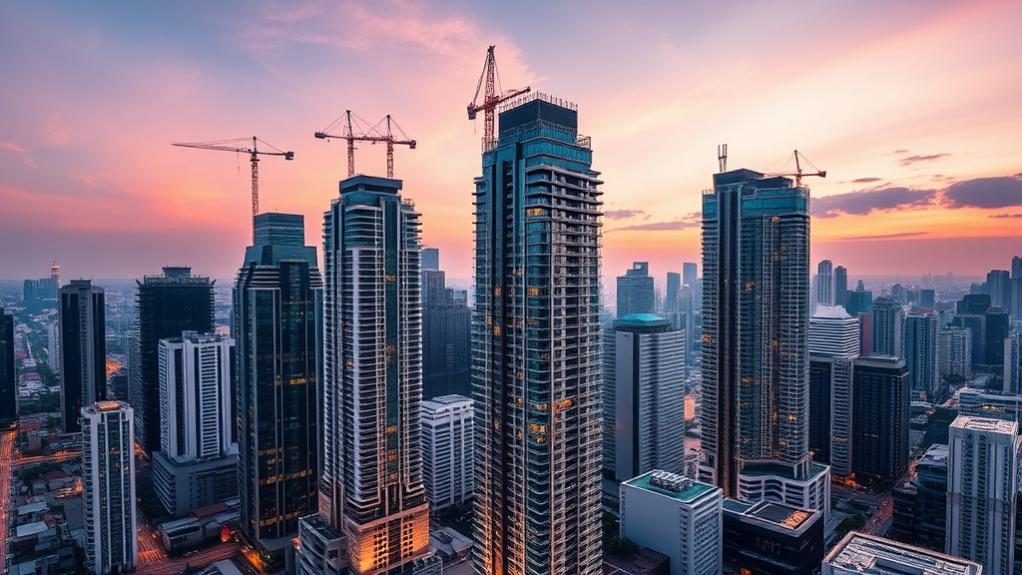
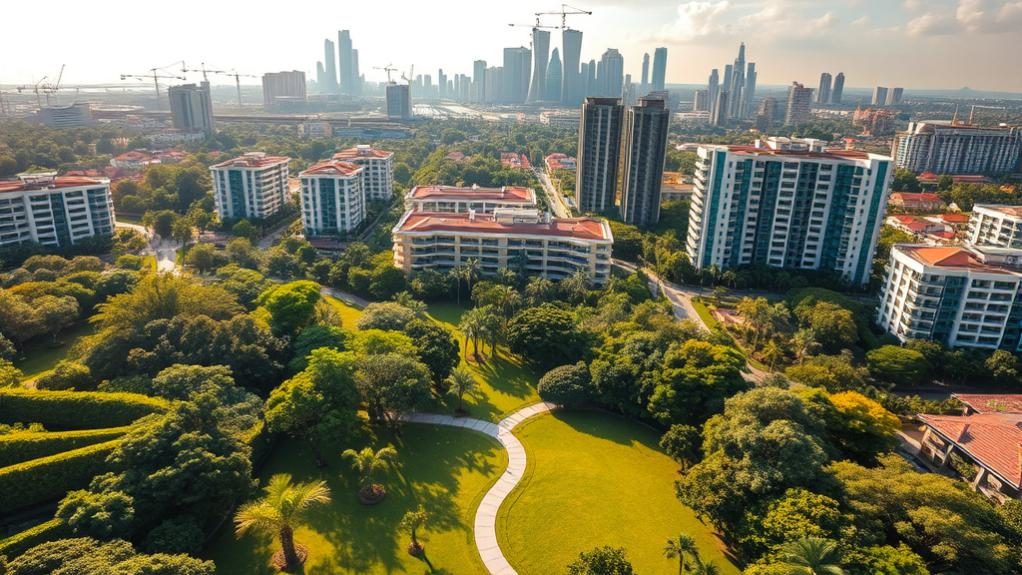
When Treasure at Tampines was announced on the site of the former Tampines Court HUDC estate, its sheer size drew intense discussion across the property sector. Spanning approximately 648,889 square feet of land with 2,203 residential units across 29 blocks, it stands as the largest private condominium development ever built in Singapore by total unit count. As the project moved from launch into completion and achieved its Temporary Occupation Permit (TOP) in December 2023, it provided clear data on how mega developments perform in terms of maintenance costs, transaction liquidity, and secondary market pricing.
The Scale of Treasure at Tampines and Its HUDC Origins
The transformation began in August 2017 when developer Sim Lian Group acquired the privatized HUDC estate Tampines Court for S$970 million in a collective sale, reflecting a land rate of about S$676 per square foot per plot ratio after factoring in lease top-up premiums. With a plot ratio of 2.8, the site offered room for a massive master-planned community along Tampines Street 11.
Planning parameters for high-density residential developments in Singapore are governed under the Urban Redevelopment Authority Master Plan. The development was designed with 29 residential blocks rising 12 storeys each, incorporating 128 communal facilities across the sprawling grounds. These include multiple themed clubhouses, several 50-meter lap pools, tennis courts, gymnasiums, and co-working lounges designed to handle the daily routines of over 6,000 residents.
Maintenance Fee Economies Across 2,203 Units
A primary operational advantage of mega developments is their ability to distribute fixed estate overheads across a large base of subsidiary proprietors. In smaller boutique condominiums with 30 to 80 units, round-the-clock security personnel, pool filtration, landscaping crews, and lift maintenance contracts place a heavy financial burden on each individual homeowner, often resulting in monthly maintenance contributions exceeding S$400 to S$600 for standard two-bedroom apartments.
At Treasure at Tampines, the maintenance fee structure represents one of the lowest in Singapore’s private condo market. A one-bedroom apartment carries a share value of 5, resulting in monthly maintenance fees of around S$150 to S$165. Typical two-bedroom and three-bedroom units carry 6 shares, paying approximately S$180 to S$198 per month, while larger four-bedroom and five-bedroom homes pay between S$210 and S$264 per month. This lower holding cost reduces negative carry for investors during vacancy periods and lowers recurring overheads for owner-occupiers, a benefit comparable to living in an executive condominium or newly completed estate.
Price Trajectory from Launch Through Temporary Occupation Permit
Sim Lian launched Treasure at Tampines in March 2019 at an initial median price of S$1,280 to S$1,340 per square foot. Given the competitive land acquisition price, the developer was able to price units attractively to maintain steady absorption across its five-year developer sales window. Between 2019 and late 2022, prices moved gradually upward as construction progressed, reaching S$1,500 to S$1,550 per square foot by the time the project fully sold out.
Following the achievement of TOP in December 2023, secondary resale and sub-sale prices climbed into the S$1,700 to S$1,850 per square foot range, with selected premium compact units crossing S$1,950 per square foot. Over 400 secondary transactions recorded since completion have delivered solid capital gains for early buyers, with average gross profits ranging from S$200,000 to over S$400,000 for standard three-bedroom units. Understanding how construction stages and completion handovers operate can be explored in our review of how Singapore new condo handover schemes affect buyers.
Liquidity Advantages and Secondary Market Depth
One notable benefit of a 2,200-unit condominium is exceptional transaction velocity. In smaller private projects, months can pass without a single caveat lodged with the Singapore Land Authority, leaving bank valuers with sparse recent comparable data. This can sometimes result in conservative valuations during resale transactions.
Treasure at Tampines experiences consistent monthly sales activity, creating a steady stream of registered transactions in official URA caveats. This high market depth provides bank valuers and incoming buyers with continuous, reliable price benchmarks. Prospective buyers can easily verify recent transacted prices for identical stack configurations and floor levels, minimizing valuation shortfalls when securing bank financing under the MAS residential mortgage loan regulations. In addition, its location near Simei MRT on the East-West Line and Tampines West MRT on the Downtown Line ensures sustained rental demand from staff working at Changi Business Park and Changi Airport, supported by the extensive LTA rail network expansion.
Managing Internal Supply and Stack Competition on Exit
While mega developments provide scale and cost efficiencies, exiting owners face distinct marketing challenges. The main headwind is internal competition. With 473 two-bedroom and 761 three-bedroom apartments in the project, an owner wishing to sell will frequently find multiple identical or comparable floor plans listed on property portals simultaneously.
When buyers can choose between several matching units, pricing becomes sensitive to specific unit attributes. Units facing the Pan Island Expressway (PIE) experience traffic noise, creating a pricing discount compared to quiet inner pool-facing or landscape-facing stacks. Sellers in mega developments cannot rely solely on the overall estate reputation; they must differentiate through interior upkeep, high-floor positioning, or flexible handover timelines. Similar scale and absorption dynamics are evident when assessing other suburban master-planned projects, such as the Lucerne Grand mixed-use development launch. For buyers, mega projects offer affordability and complete amenities, but exit timing requires realistic stack-level pricing.