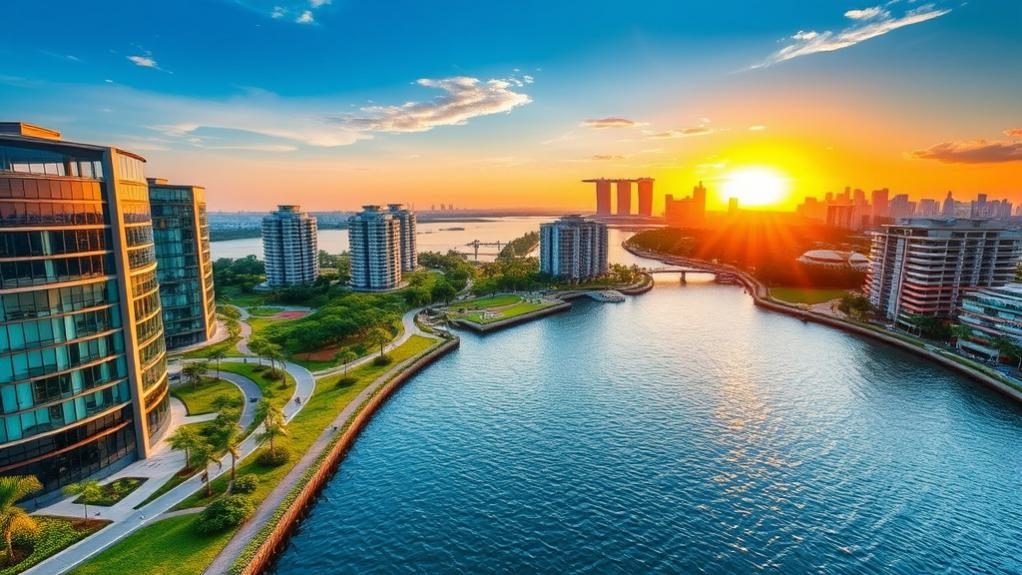
Kampong Bugis is planned as a new waterfront neighbourhood at the mouth of the Kallang River, close to the city centre. The headline ambition remains about 4,000 homes, but the route to delivering them has changed since the site was first offered through the Government Land Sales (GLS) programme.
The important distinction is that Kampong Bugis is still a planning and land-preparation story, not a completed housing precinct or an announced condominium launch. As of September 2026, no firm date has been published for the first Kampong Bugis residential sale or for completion of the whole neighbourhood.
What is planned at Kampong Bugis
The future precinct occupies a strategic stretch between Kallang Road, Crawford Street, Rochor Canal and the Kallang River. Earlier plans centred on an 8.2ha GLS site within the wider 17ha precinct. In 2019, that land was conceived as four White-site plots capable of accommodating up to 4,000 private homes, together with as much as 50,000 sq m of complementary space for uses such as shops, offices, community facilities, serviced apartments, sports and recreation.
The broad vision is for a mixed, people-oriented waterfront district rather than an isolated cluster of residential towers. Homes are intended to sit alongside publicly accessible spaces, everyday amenities and connections to the river. The estimate of about 4,000 homes remained in the authorities’ plans when the land-use layout was revised in 2025, but it should be read as a precinct-level planning figure rather than a confirmed unit count for a single project.
Kampong Bugis also forms part of a broader planning direction under Singapore’s Master Plan. Readers who want the national context can see our overview of the URA Master Plan 2025.
Why the 2025 land-use plan matters
The original model envisaged one master developer buying, planning and building the four plots in phases. By 2025, however, the map no longer treated all four in the same way. Two remained White sites. The boundaries of the other two were redrawn: one was divided into two residential plots by a new road, while another was designated mainly for housing with commercial use at the first storey.
That revision creates scope for smaller and more clearly defined parcels, although it does not by itself confirm how or when each parcel will be sold. URA said agencies were reviewing the delivery approach and would undertake necessary land preparation and infrastructure, including a new road and utilities network. It had not confirmed that the entire precinct would still be awarded to one master developer.
This is why the old site statistics should not be presented as current tender conditions. The former 390,000 sq m maximum gross floor area, 99-year tenure and 11-to-13-year development period belonged to the earlier master-developer sale framework. Fresh GLS documents will be needed to establish the binding tenure, yield, use mix and completion requirements for any future parcel.
The timeline remains dependent on site preparation
The former Kallang Gasworks occupied part of Kampong Bugis, so the land requires treatment before redevelopment. Remediation began in 2020. In March 2022, URA removed the Kampong Bugis White site from the GLS Reserve List because completion of those works had been delayed and said the Government would review development staging.
The revised layout appeared in Draft Master Plan 2025 and was subsequently reflected in the planning framework, but a land-use designation is not the same as a site launch. A private project still requires a parcel to be released, tendered and awarded before detailed design, sales and construction can follow. As of September 2026, the authorities had not announced a completion date for the remediation works or a fresh Kampong Bugis tender.
Accordingly, the previously stated 11-to-13-year period should not be treated as a countdown from 2019 or 2025. It described how long the earlier master developer would have had to complete the precinct after the relevant sale. Buyers comparing other future estates can use our guide to new housing areas near MRT stations to distinguish a master-plan proposal from a launched or completed project.
Waterfront access and car-lite design remain central
Kampong Bugis was conceived as a car-lite precinct with walking and cycling prioritised in its street design. Kallang, Lavender and Bendemeer MRT stations serve the wider area on the East-West and Downtown lines. Actual walking distance will vary by parcel and by the final network of crossings, paths and entrances, so it is more accurate to describe the precinct as being near three stations than to promise every future home doorstep access.
The river is more than a view corridor. URA’s current plans for the Kallang River Identity Corridor call for better walking and cycling links, new community nodes, active waterfront frontages, landscaping, shops and eateries. Phase 1 of the Bishan-to-City links has been completed, while a cycling bridge over the Pan-Island Expressway is targeted for completion in 2027.
Kallang Riverside Park already provides open space beside the precinct. Future development is expected to improve the relationship between buildings, parkland and the waterfront, while district-level infrastructure proposed under the earlier concept included pneumatic waste collection and stormwater treatment. Exact requirements should again be checked against the conditions attached to each future land parcel.
Kampong Bugis is part of a wider Kallang pipeline
Activity nearby should not be confused with delivery of the 4,000-home precinct. In April 2026, URA awarded the separate Kallang Close residential site to a Frasers Property and Mitsubishi Estate joint venture. That 11,456.3 sq m, 99-year leasehold parcel has a maximum gross floor area of 40,098 sq m and was previously estimated to yield about 470 homes.
Kallang Close provides tangible evidence that new housing is moving into the broader Kallang River corridor, but its homes are not part of a launched Kampong Bugis project. Other planned housing areas along the river, including Kallang Distripark and Tanjong Rhu, will likewise follow their own planning, sale and construction schedules.
The wider programme could eventually create a more continuous residential and recreational corridor linking established estates, new waterfront homes and the Kallang Alive sports precinct. Its effect will unfold in stages rather than through one simultaneous transformation.
What prospective buyers and nearby owners should watch
For prospective buyers, the next meaningful milestones are completion of site preparation, confirmation of the development model, inclusion of specific parcels in a GLS programme, tender conditions and an award. Those documents will reveal matters that cannot yet be known, including the precise unit mix, launch sequence, commercial provision, parking standards and construction timetable.
Nearby owners may eventually gain access to more amenities, improved public spaces and better waterfront connections. They may also face years of construction, changing views and additional housing supply. It would be premature to conclude that the redevelopment has already increased property values: prices are also shaped by tenure, age, unit attributes, interest rates, market supply and broader economic conditions.
Kampong Bugis remains a long-term housing plan with a clear waterfront and car-lite direction, but substantial implementation details are unresolved. The 4,000-home estimate is useful for understanding the intended scale; it is not yet a promise of 4,000 units arriving by a fixed date.


