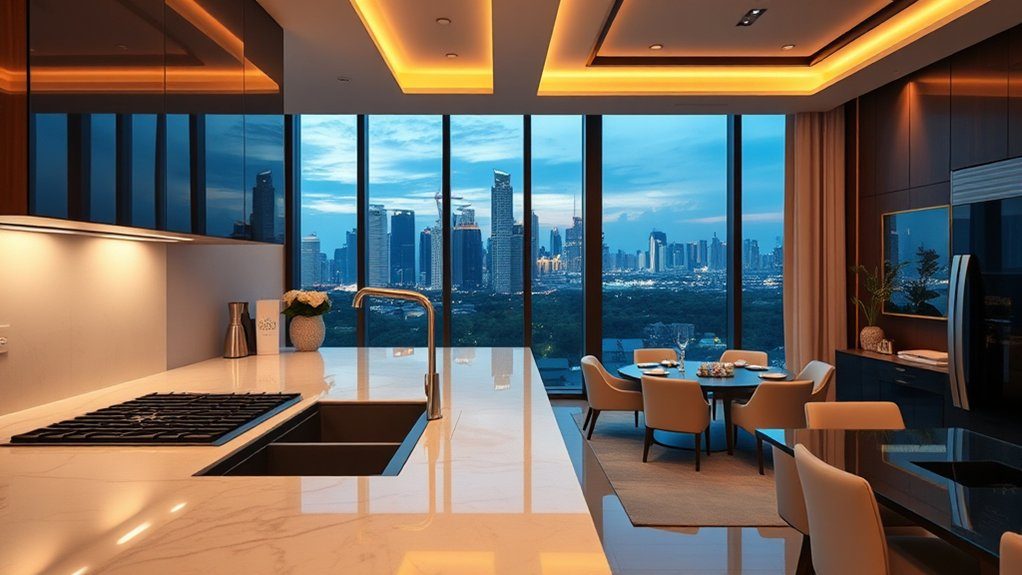
For many Singaporean families, moving from an HDB flat to a private condominium is a major housing step. After fulfilling the 5-year Minimum Occupation Period (MOP) and seeing capital growth on their flats, households frequently explore private housing options across the Outside Central Region (OCR) and Rest of Central Region (RCR). Yet many buyers discover that the total cash and equity commitment exceeds their initial rough calculations.
The gap between the selling price of an HDB flat and the purchase price of a private home is only the starting point. When buyers factor in stamp duties, statutory refund requirements to their Central Provident Fund (CPF) accounts, financing constraints, and monthly estate maintenance charges, the financial buffer needed to upgrade safely becomes substantial.
The Upfront Cash and CPF Down Payment Reality
Under Monetary Authority of Singapore (MAS) regulations, the maximum Loan-to-Value (LTV) limit for a residential property bank loan is 75% for buyers with no outstanding housing loans. This requirement means buyers must provide a minimum 25% down payment on the purchase price of their private condominium.
At least 5% of the purchase price must be paid in cash. The remaining 20% can be funded through ordinary account balances from the CPF Board, available cash, or net cash proceeds from the sale of the previous home. For a modest resale condominium or entry-level new launch priced at S$1.8 million, that 25% down payment equals S$450,000, of which at least S$90,000 must be in hard cash.
On top of the down payment, buyers must pay Buyer’s Stamp Duty (BSD) on the purchase price or market valuation, whichever is higher. Under current Inland Revenue Authority of Singapore (IRAS) BSD rates, residential property transactions are taxed in tiers: 1% on the first S$180,000, 2% on the next S$180,000, 3% on the next S$640,000, 4% on the next S$500,000, and 5% on the portion between S$1.5 million and S$3 million. On an S$1.8 million condominium, the BSD works out to S$59,600. When combined with legal conveyancing fees and valuation charges, the upfront capital outlay easily approaches S$515,000 before a single monthly mortgage instalment begins. Buyers who compare private purchases against executive condominiums should note that initial outlays differ significantly, as detailed in our guide on executive condominium down payment costs.
CPF Accrued Interest and the Housing Refund Trap
The most common surprise for HDB upgraders is not the price of the condominium, but the net cash remaining from their HDB flat sale. Many homeowners assume that selling a 4-room or 5-room flat for S$750,000 will leave them with a sizable cash windfall. However, Singapore housing rules require that any CPF Ordinary Account savings used to purchase the flat must be refunded in full upon sale.
This refund includes not only the principal sum withdrawn for the initial down payment and monthly instalments, but also the accrued interest that those funds would have earned had they remained in the CPF Ordinary Account, calculated at 2.5% compounded per year. If a couple purchased their HDB flat ten or twelve years ago and used CPF savings consistently to cover their monthly mortgage payments, the accrued interest component can easily reach S$60,000 to S$100,000 per person.
While this money is not lost (it returns directly to the owners’ CPF Ordinary Accounts where it can be redeployed toward the new condominium down payment), it cannot be pocketed as liquid cash. If a family needs cash for private property renovation, legal fees, or emergency reserves, finding that their paper profits are locked inside CPF can disrupt their transition plans. Reviewing your transaction timeline carefully is essential, particularly for owners who sell an HDB flat right after MOP without modeling their CPF balance replenishment first.
ABSD Timing and the Remission Window for Married Couples
Upgraders face an operational dilemma: do you sell your existing HDB flat first, or do you secure your new private condominium before selling? The sequencing carries major financial ramifications under Additional Buyer’s Stamp Duty (ABSD) rules.
If a married couple buys a private condominium before legally completing the sale of their HDB flat, IRAS treats the condominium purchase as a second residential property. For Singapore Citizens, the prevailing second-property ABSD rate is 20%. On an S$1.8 million purchase, that amounts to S$360,000 payable within 14 days of exercising the Option to Purchase (OTP) or executing the Sale and Purchase Agreement.
Married couples with at least one Singapore Citizen spouse can apply for IRAS ABSD remission, but strict conditions apply. The couple must sell their first residential property within six months of the date of purchase for completed properties, or within six months of the Temporary Occupation Permit (TOP) date for uncompleted properties. In addition, they must not acquire any other residential property before the disposal of the first property. Coming up with S$360,000 in upfront cash or CPF just to hold it during the transition creates immense liquidity stress, prompting some buyers to consider ownership restructuring strategies, though there are hidden risks of decoupling property ownership to avoid ABSD that must be evaluated thoroughly.
Loan Limits and the MAS 55% TDSR Stress Test
Financing a private home involves stricter debt checks than an HDB housing loan. When assessing loan applications, commercial banks apply the MAS Total Debt Servicing Ratio framework, which caps total monthly debt obligations at 55% of the borrower’s gross monthly income.
Banks do not evaluate mortgage affordability using prevailing promotional interest rates. Instead, MAS mandates a medium-term interest rate floor, currently set at 4.0% per annum for residential property loans, to stress-test borrowers against future rate hikes. On a 75% loan of S$1,350,000 amortized over a 30-year tenure, calculating repayments at a 4.0% stress rate results in a monthly debt commitment of approximately S$6,445.
To pass the 55% TDSR threshold with no other existing debts, a household needs a verifiable monthly income of at least S$11,720. If the buyers have existing car loans, education loans, or credit card facilities amounting to S$1,500 each month, the gross monthly household income required jumps to more than S$14,450. Upgraders entering their late thirties or early forties must also keep in mind that loan tenure is capped at 65 minus the buyer’s average age for maximum LTV, which means shorter tenures and higher monthly repayments.
Recurring Holding Costs: Maintenance Fees, Taxes, and Sinking Funds
Beyond the acquisition phase, holding a private condominium involves significantly higher recurring overhead than public housing. In an HDB flat, Town Council Service and Conservancy Charges (S&CC) typically range between S$65 and S$100 per month for 4-room and 5-room flats, often offset by seasonal government rebate vouchers.
In a private condominium, the Management Corporation Strata Title (MCST) collects monthly maintenance fees and sinking fund contributions. Depending on the size of the development, the share value assigned to your unit, and the density of facilities such as swimming pools, tennis courts, gymnasiums, and round-the-clock security, monthly MCST fees generally range from S$300 to S$600. In smaller boutique developments with fewer units to share common costs, monthly fees can climb higher. Over a ten-year holding period, a S$450 monthly fee adds S$54,000 to your non-recoverable housing costs.
Annual property taxes also rise noticeably. Property tax is calculated based on the Annual Value (AV) determined by IRAS, which reflects the estimated annual rental value of the home. Because private condominiums command higher rental values than HDB flats, their AVs are substantially higher, placing them in steeper tiers of Singapore’s progressive owner-occupier property tax schedule. When factoring in higher home insurance premiums, private estate upkeep, and mortgage interest, the ongoing cost of living in a condominium requires a resilient monthly cash-flow cushion.

One thought on “Why Upgrading to a Condo in Singapore Can Cost More Than You Expect”