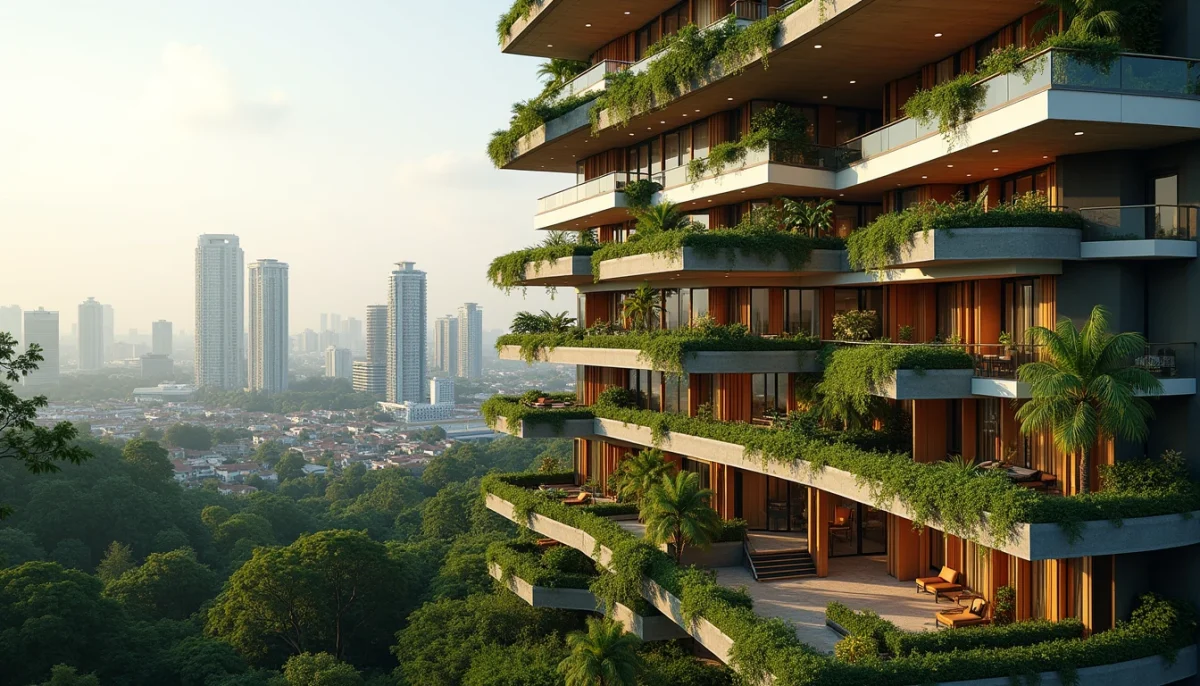
Reflections at Keppel Bay stands as one of the most visually distinctive landmarks along Singapore’s southern coastline. Designed by internationally acclaimed architect Daniel Libeskind as his first residential project in Asia, the development features six curving glass towers rising between 24 and 41 storeys, punctuated by 11 low-rise villa blocks along Keppel Bay. Completed in 2011 by developer Keppel Land, the 1,129-unit luxury waterfront project was celebrated globally for its daring deconstructivist aesthetic. However, its long-term financial performance on the secondary market tells a more complicated story, offering critical lessons on the balance between avant-garde architecture, daily livability, and capital growth.
The Deconstructivist Design and Floor Plan Realities
From an aesthetic perspective, Reflections at Keppel Bay is an undeniable architectural achievement. Its sculptural towers gently curve toward the sky, crowned by steel roof lattices and connected by high-level sky bridges. However, translating dramatic exterior curves into functional residential interiors introduces practical living challenges.
Because the building envelopes taper and bend, floor plates vary continuously across vertical stacks. In many apartments, walls meet at non-standard acute or obtuse angles rather than clean 90-degree right angles. These irregular layouts create fan-shaped living rooms and angled bedrooms where standard off-the-shelf furniture cannot sit flush against perimeter walls. Owners and tenants frequently have to commission expensive customized carpentry for wardrobes, bed frames, and storage cabinets. Furthermore, massive structural shear walls and transfer columns necessary to support the twisting towers encroach into usable living zones, creating spatial dead corners that cannot be easily utilized.
Strata Inefficiencies and Pre-2013 Balcony Rules
A major factor affecting the resale pricing of Reflections at Keppel Bay relates to historical building guidelines. The project was designed and approved prior to the Urban Redevelopment Authority’s 2012 and 2013 regulatory revisions, which tightened the treatment of non-air-conditioned spaces. Modern development standards are now governed under the URA development control guidelines.
Under the older regulatory framework, developers could build extensive private enclosed spaces (PES), oversized air-conditioner ledges, deep planter boxes, and expansive open-sky roof terraces that were counted in the saleable strata floor area. At Reflections, large four-bedroom units and penthouses often feature extensive uncovered terraces or double-volume voids. While impressive on architectural renderings, these outdoor spaces require regular cleaning, are exposed to tropical heat and rain, and dilute the net air-conditioned living area. When prospective buyers calculate value on a price-per-square-foot basis of usable indoor space, older generous strata layouts often appear less efficient than modern, tightly optimized floor plans.
Coastal Marine Exposure and Facade Maintenance Demands
Maintaining a massive glass-fronted residential complex located directly on the seafront requires substantial recurring capital expenditure. The development sits immediately along Keppel Harbour facing the Singapore Strait, subjecting its exterior glass curtain walls, structural silicone seals, and metallic framing to aggressive marine atmospheric conditions, including airborne chlorides and high ultraviolet exposure.
Standard vertical cleaning cradles cannot service the complex double-curved towers. Instead, the property utilizes specialized Building Maintenance Units (BMUs) featuring articulated telescopic arms and cable restraint systems that navigate both convex and concave glass surfaces. In addition to facade upkeep, the estate incorporates an expansive 100,000-square-foot reflecting pool and communal water features that earned recognition from the Building and Construction Authority (BCA) for green design. However, servicing these water features, sky bridges, and automated building access systems requires significant management and sinking fund contributions, resulting in monthly maintenance fees often ranging between S$700 and well over S$1,200 for larger three-bedroom and four-bedroom apartments.
Price Performance Compared to Keppel Bay Neighbors
When Reflections was launched in 2007 during an exuberant peak in Singapore’s luxury property market, early units were snapped up at prices averaging S$2,000 to over S$2,700 per square foot, with select penthouses setting record price levels. In the secondary resale market over subsequent years, transacted prices have largely hovered between S$1,650 and S$1,800 per square foot. Historical caveat data shows that a significant number of resale transactions at Reflections were executed at prices below their original purchase price, making it one of the few luxury projects with extensive recorded secondary losses.
In contrast, Caribbean at Keppel Bay, completed in 2004 with a 99-year lease dating from 1999, has demonstrated stronger secondary resale pricing, often transacting at S$1,850 to S$1,950 per square foot. Despite being an older development, Caribbean features straightforward rectangular floor plates, minimal wasted bay window space, and an entry price point that allowed capital appreciation over time. Buyers acquiring high-end waterfront units must also account for progressive duties detailed under the IRAS Buyer’s Stamp Duty, which adds substantial upfront cost to large-ticket acquisitions.
The Greater Southern Waterfront and Long-Term Leasehold Horizons
The future of the Keppel Bay precinct is intertwined with Singapore’s Greater Southern Waterfront (GSW) master plan, which will free up approximately 2,000 hectares of prime coastal land following the relocation of port terminals to Tuas. Nearby developments and coastal planning shifts are examined in detail in our analysis of why the Greater Southern Waterfront impacts the southern coast.
While the transformation brings new lifestyle amenities, nature corridors, and continuous coastal promenades, it also introduces competitive private residential supply on fresh 99-year leases, such as new developments around the former Keppel Club site discussed in our coverage of the Berlayar Drive land tender award. As Reflections at Keppel Bay navigates its remaining leasehold horizon, its appeal will increasingly rest on buyers who value its one-of-a-kind architectural profile and serene marina lifestyle over pure capital appreciation.