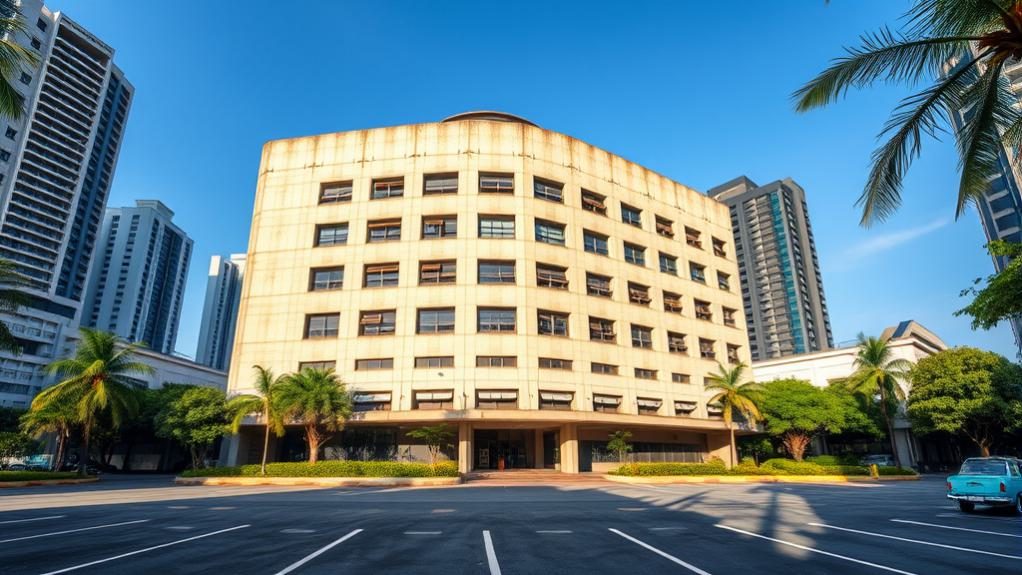
The Tan Boon Liat Building along Outram Road has stood as one of Singapore’s most prominent industrial commercial landmarks and a renowned hub for designer furniture, lifestyle showrooms, and creative studios. When the 15-storey freehold property was launched for collective sale at an ambitious reserve price of S$1.15 billion in early 2025, the tender closed without attracting a single bid. However, this initial setback catalyzed a realistic repricing that culminated in July 2026 with a successful en bloc sale to Kingsford Group for S$950 million, making it Singapore’s largest collective sale of 2026.
Site Attributes and URA Rezoning Potential
Located at 315 Outram Road, the Tan Boon Liat Building occupies a substantial freehold land area of 175,655 square feet. Under the operative Master Plan, the site is zoned Business 1 (Industrial) with a baseline gross plot ratio of 3.1. However, given its prime fringe location adjacent to the Central Business District and the heritage enclave of Tiong Bahru, the property held potential for significant redevelopment.
Prior to the initial tender launch, the collective sale committee explored outline planning permission with the Urban Redevelopment Authority to rezone the site for mixed-use commercial and residential development. A rezoning could potentially raise the gross plot ratio to 4.9, unlocking an allowable building height of up to 180 metres above mean sea level. Such planning flexibility would permit a substantial increase in gross floor area, combining ground-level retail with high-density private condominium towers.
The site’s strategic positioning directly adjacent to Havelock MRT station on the Thomson-East Coast Line provides exceptional public transport accessibility. Commuters can reach Orchard Road and Shenton Way within three to four stops, making the parcel an attractive redevelopment proposition for urban residential living.
Why the Initial S$1.15 Billion Collective Sale Stalled
Despite the site’s appealing locational attributes, the initial tender closing in March 2025 failed to secure any bids from institutional developers or joint-venture consortiums. Several macroeconomic and financial factors contributed to this cautious reception:
First, the S$1.15 billion price tag required an immense upfront capital commitment. In an environment of elevated global interest rates and high construction financing costs, very few developers had the balance-sheet capacity to absorb a multi-billion-dollar development risk on a single suburban site.
Second, converting a Business 1 industrial site to high-value commercial and residential use triggers substantial Land Betterment Charges (LBC) payable to the state. As land records administered by the Singapore Land Authority indicate, development premiums can run into hundreds of millions of dollars, compressing developer profit margins unless the land reserve price is structured conservatively.
Third, developers were wary of high inventory absorption risks. Redeveloping the site to a plot ratio of 4.9 would yield over 1,000 new residential units, requiring aggressive sales velocity to meet the statutory five-year Additional Buyer’s Stamp Duty remission timeline.
Market Realism and the S$950 Million Breakthrough
Recognizing that the original reserve price exceeded market appetite, the Tan Boon Liat Building collective sale committee engaged in intensive consultations with strata owners to reset valuation expectations. Securing the legally mandated 80% consensus under Singapore’s strata laws requires balancing owner windfalls against developer feasibility, a topic covered extensively in our guide to en bloc consent thresholds and legislative updates.
By lowering the reserve price from S$1.15 billion to S$950 million, the owners closed the pricing gap between seller aspirations and developer economics. The recalibrated pricing immediately drew serious bids, resulting in a private treaty deal with Chinese-backed developer Kingsford Group. The transaction represents a crucial benchmark for Singapore’s en bloc market, demonstrating that prime freehold parcels can clear successfully when vendors adopt realistic pricing.
Similar pricing adjustments have proven essential across other major estates seeking collective exits, as observed in our review of price reductions at Serenity Park en bloc. Sellers who recognize shifting market parameters are far more likely to achieve successful collective sales than those who hold firm to peak-market valuations.
Tenant Relocation and the Evolution of Outram’s Furniture Hub
For decades, the Tan Boon Liat Building has been recognized by Singapore interior designers, expatriates, and homeowners as an eclectic destination for designer furniture, vintage home accessories, and boutique art galleries. The multi-storey building housed dozens of independent brands and flagship furniture retailers operating under industrial showroom guidelines.
The successful collective sale signals the eventual winding down of this vibrant creative cluster. Tenants have begun scouting alternative commercial and light industrial locations across Singapore, including industrial hubs in Tai Seng, Pasir Panjang, and Kallang. While the dispersal marks the end of an era for Outram’s furniture scene, it opens a fresh chapter of modern urban renewal along the Singapore River fringe.
Implications for Singapore’s En Bloc Market and Urban Renewal
The sale of Tan Boon Liat Building to Kingsford Group for S$950 million stands as Singapore’s largest collective sale of 2026, injecting fresh optimism into a previously subdued en bloc environment. Alongside deals such as the S$880 million sale of Loyang Valley, it proves that institutional developers remain eager to replenish land banks when prime locations offer compelling redevelopment potential at workable breakeven prices.
Looking ahead, Kingsford’s planned redevelopment of 315 Outram Road will transform the low-slung industrial warehouse into a modern mixed-use residential landmark. Situated between the historic conservation shophouses of Tiong Bahru and the commercial skyscrapers of the central business district, the project will bring hundreds of new households into one of Singapore’s most culturally distinctive urban neighbourhoods.

One thought on “Tan Boon Liat Building’s S$1.15 Billion Sale Ends Without a Single Bid”