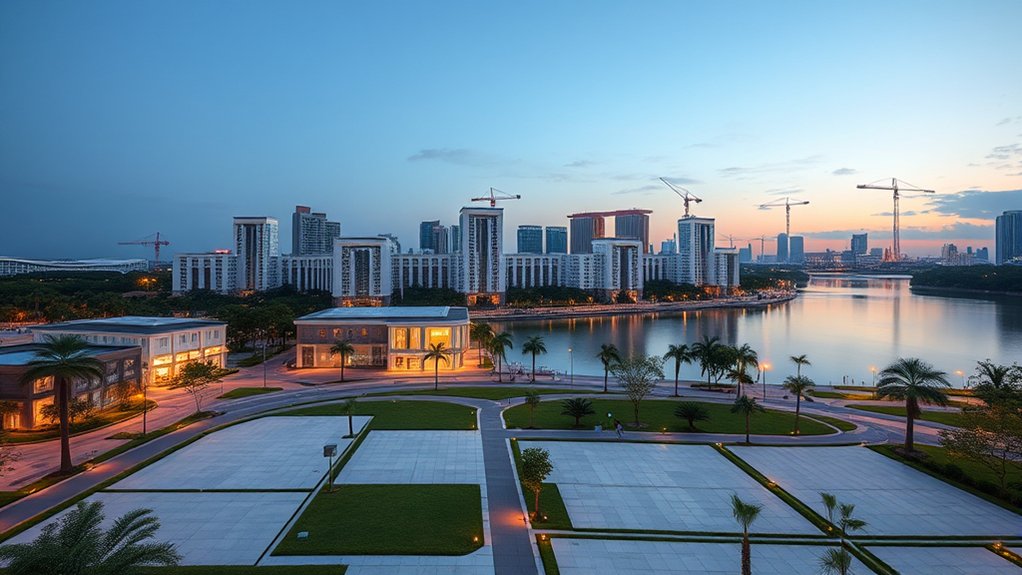
Singapore’s prime Core Central Region residential sector is navigating a meaningful expansion in new private home inventory. Following several quarters of subdued project releases, developers are rolling out approximately 2,500 prime residential units across Districts 9, 10, 11, and the Downtown Core. This surge in high-end supply marks a significant departure from previous years, when developer activity concentrated predominantly in the Outside Central Region and the Rest of Central Region.
The wave of prime launches arrives at a pivotal juncture for Singapore’s luxury property market. Developers who acquired Government Land Sales parcels and private en bloc sites are bringing curated projects to market, carefully calibrating launch pricing to appeal to local high-net-worth families, family office principals, and regional investors navigating established tax frameworks.
Prime Pipeline Expansion Across Districts 9, 10, and the Downtown Core
The upcoming supply is distributed across Singapore’s most prestigious postal districts. In District 9 and District 10, boutique and mid-sized luxury residences are launching along Orchard Boulevard, River Valley, and Holland Road, providing exclusive addresses with low-density architectural designs. Meanwhile, the Downtown Core and Marina Bay precincts are welcoming mixed-use developments that blend luxury residences with Grade A commercial space and retail dining amenities.
Developers are differentiating their offerings by incorporating hospitality-inspired concierge services, private dining pavilions, bespoke architectural finishes, and comprehensive smart-home systems designed to appeal to sophisticated owner-occupiers.
This expanding pipeline provides luxury buyers with a level of choice that has been absent from the Core Central Region for several seasons. As tracked in our reporting on CCR luxury housing demand revival and market pricing dynamics, buyer interest has increasingly gravitated toward well-executed prime projects where price per square foot differentials against suburban benchmarks offer compelling comparative value.
Official planning permissions, master zoning details, and quarterly real estate statistics published by the Urban Redevelopment Authority illustrate how residential densities in the central area are being actively enhanced through sustainable urban regeneration programmes.
Buyer Demographics: Shifting from Overseas to Domestic Capital
The profile of buyers entering the Core Central Region has transformed substantially over recent quarters. Prior to 2023, prime residential sales in Districts 9 and 10 saw active participation from overseas foreign buyers seeking global wealth diversification. However, the introduction of a 60 percent Additional Buyer Stamp Duty rate on foreign residential acquisitions has recalibrated the buyer pool.
Today, primary demand in the luxury sector is spearheaded by Singapore citizens, newly naturalized citizens, and permanent residents purchasing their primary homes or acquiring properties for their adult children. These domestic purchasers possess substantial liquidity, low gearing levels, and a long-term investment horizon. Regulatory details on property taxation and duty remissions administered by the Inland Revenue Authority of Singapore confirm that local first-time home buyers continue to enjoy standard buyer stamp duty rates without additional punitive levies.
Recent high-profile transactions, including distressed asset sales reviewed in our report on seized AML luxury condominiums sold at auction in prime CCR, demonstrate that well-capitalized local purchasers step in decisively when prime assets are priced realistically against current market realities.
Price Spreads Between CCR and City-Fringe Developments
One of the primary drivers supporting CCR absorption is the compression of price differentials between prime and city-fringe developments. During 2022 and 2024, new launches in the Rest of Central Region routinely set benchmarks above $2,500 to $2,800 per square foot, with select Outside Central Region executive projects approaching $2,200 per square foot.
With prime CCR developments launching at competitive levels between $2,900 and $3,400 per square foot, many affluent buyers perceive high-end central properties as offering superior long-term capital preservation. The narrowing price gap makes upgrading from an older city-fringe apartment to a newly constructed District 9 or 10 home an attractive proposition for multi-generational families.
Prospective purchasers evaluating project availability and regional launches can consult Pat Ko’s comprehensive review of upcoming new launch condominiums in Singapore for 2026 to assess regional supply pipelines and comparative unit pricing across districts.
Land Tender Costs and Developer Margin Management
Developers managing prime developments face tighter operating margins due to high land acquisition costs and elevated construction overheads. Recent Government Land Sales tenders in prime zones demonstrate that developers are bidding with disciplined financial models, factoring in financing costs and marketing lead times.
Monetary policy settings and interest rate guidelines overseen by the Monetary Authority of Singapore directly influence mortgage costs and developer financing structures. While global interest rates have eased from their peak levels, borrowing costs remain higher than the ultra-low regime of the previous decade, prompting developers to adopt phased sales releases rather than aggressive speculative pricing.
Furthermore, residential developers are subject to the five-year ABSD remission timeline, which mandates that projects of all sizes must be fully sold within five years from land acquisition to avoid severe financial penalties. This regulatory requirement incentivizes developers to launch with sensible price points that ensure steady sales velocity throughout the project lifecycle.
Strategic Considerations for Buyers in Prime Districts
For individuals and families considering an acquisition in the Core Central Region, meticulous financial planning is essential. Prospective buyers must evaluate whether the development offers freehold tenure or a 99-year leasehold title, as tenure continues to exert a noticeable influence on long-term capital appreciation and en bloc potential in prime districts.
Layout efficiency is another critical consideration. High-end buyers are increasingly prioritizing functional living spaces, private lift lobbies, quality building materials, and low monthly maintenance charges over excessive decorative facilities. By conducting thorough due diligence and selecting well-located developments near established transit nodes and reputable schools, purchasers can position themselves effectively within Singapore’s enduring prime residential market.