Selling a private condominium at a financial loss in Singapore’s tightly regulated, historically appreciating property market is statistically uncommon. Across the island over the past 12 months, only 5.2% of non-landed private residential resales transacted below their owners’ original acquisition price. Yet at Marina One Residences, Singapore’s flagship integrated mixed-use landmark in the heart of the Downtown Core (District 01), unprofitable exits have become an overwhelming reality: 45 out of 46 resale transactions (97.8%) closed at a loss over the 12 months leading to 18 October 2026.
According to comprehensive caveat analysis, the typical outgoing seller at Marina One Residences absorbed a median loss of approximately S$339,000, representing an average price haircut of -18.4% before factoring in legal fees, buyer’s stamp duties (BSD), and agent commissions. With sellers originally purchasing at a median of $2,282 PSF around 2019 and exiting at $1,905 PSF after an average holding period of 7.2 years, this divergence from the broader market provides a masterclass in the unique financial dynamics of high-density Central Business District (CBD) residential investments.
Not a One-Year Glitch: The Multi-Year Loss Velocity
Far from being a temporary market anomaly or a localized distressed liquidation, historical transaction audits reveal that resale underperformance at Marina One Residences has persisted across multiple market cycles:
| Review Window | Matched Resales | Loss-Making Deals | Unprofitable Share (%) | Median Net Loss | Median Loss (%) |
|---|---|---|---|---|---|
| 12 Months to Oct 2026 | 46 | 45 | 97.8% | -$339,000 | -18.4% |
| Preceding 12 Months (2024–2025) | 20 | 19 | 95.0% | -$315,000 | -17.1% |
| Islandwide Non-EC Resale Market | 10,812 | 562 | 5.2% | +$385,000 (Median Profit) | +28.6% (Median Gain) |
Notably, these losses were not isolated to buyers who purchased at the peak of a specific property bubble. Across 47 matched transactions, sellers originated from diverse buying vintages: 15 purchased in 2014 (launch year), 2 in 2016, 6 in 2018, 6 in 2019, 11 in 2020, and 7 between 2021 and 2023. Whether holding for 12 years or 3 years, almost every owner who exited between late 2025 and late 2026 settled for prices below their initial purchase price, with only one single transaction logging a modest gain of +3.2%.
The 4 Root Causes: Why CBD Integrated Giants Struggle on Resale
On paper, Marina One Residences possesses every attribute of a blue-chip real estate asset: world-class architecture by Ingenhoven Architects, direct subterranean links to four MRT lines (Downtown, Marina Bay, Shenton Way, and Tanjong Pagar), a 65,000 sq ft Biodiversity Garden, and Grade-A office towers housing global tech and finance giants. Why, then, does the secondary market punish it so severely?
1. Commercial Work Hub vs. True Residential Enclave
Being an ultra-convenient place to live while working 60-hour weeks in the CBD is not synonymous with being a desirable permanent home for the broader domestic resale market. Unlike prime residential enclaves such as Tanglin / Grange Road, River Valley, or Bukit Timah, Marina Bay functions primarily as a commercial and financial grid. Outside business hours, the precinct lacks the neighborhood warmth, community parks, hawker centers, and most critically, priority primary schools. With zero popular co-ed or SAP primary schools within 1 km, domestic Singaporean families — who constitute more than 85% of active secondary market buyers — completely bypass Marina Bay.
2. The Generous Floor Plate Quantum Trap
Unlike newer Outside Central Region (OCR) and Rest of Central Region (RCR) developments designed with hyper-compact floor plans to manage absolute price tags, Marina One Residences was conceived during an era of generous spatial luxury:
- 2-Bedroom Apartments: Range between 969 sq ft and 1,281 sq ft.
- 3-Bedroom Apartments: Span between 1,507 sq ft and 1,593 sq ft.
- 4-Bedroom Suites & Penthouses: Exceed 2,045 sq ft to 8,000+ sq ft.
While spatial volume is prized, it inflates the absolute capital requirement. Even at a deeply discounted rate of $1,905 PSF, a standard 1,507 sq ft 3-bedroom unit commands approximately $2.87 million. At a $2.8M to $3.2M budget, local family purchasers face an abundance of alternatives, including prime freehold resale condominiums in District 09, 10, or 15 that offer school priority and lower long-term lease decay anxiety.
3. Foreign Buyer Exits Evaporated Under 60% ABSD
When M+S Pte Ltd (a joint venture of Khazanah Nasional and Temasek Holdings) launched Marina One in 2014, the development experienced substantial international absorption, characterized by foreign institutional investors and overseas ultra-high-net-worth individuals purchasing multi-unit packages. However, with successive rounds of property cooling measures culminating in the 60% Additional Buyer’s Stamp Duty (ABSD) on foreign purchasers, the natural secondary exit audience for trophy CBD apartments was abruptly severed.
Existing foreign owners wishing to liquidate have found domestic buyers unwilling to pay original developer premiums, forcing vendors to undercut one another to achieve liquidity.
4. Internal Competition Across 1,042 Units
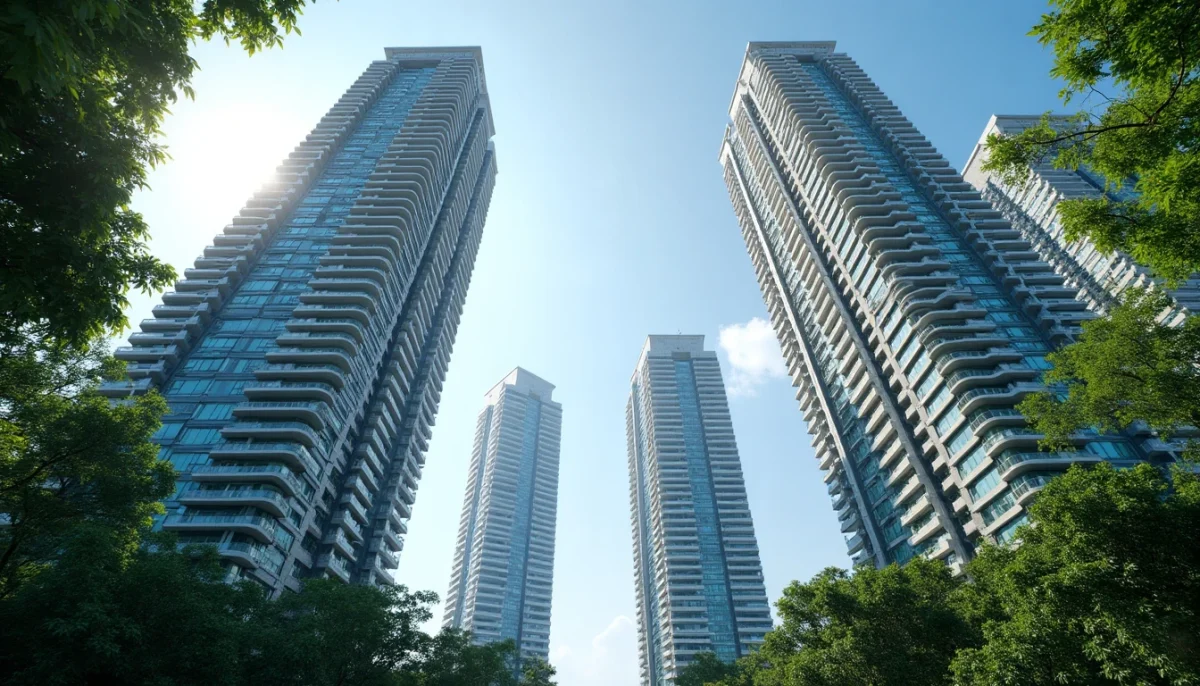
With 1,042 residential units situated across two 34-storey towers, owners face relentless internal listing competition. At any given moment, dozens of identical stack layouts are competing for the same prospective buyer or tenant. When multiple sellers are motivated simultaneously — whether due to fund rebalancing, overseas relocation, or rising alternative investment yields — transaction prices rapidly spiral downward to the lowest common denominator.
The Counter-Narrative: Is $1,905 PSF in Marina Bay a Generational Bargain?
While outgoing sellers have borne significant financial pain, the resulting price reset creates an intriguing paradox for prospective buyers and capital allocators:
- Massive Replacement Cost Arbitrage: In 2026, suburban mass-market new launches in the OCR routinely launch between $2,200 and $2,550 PSF, while RCR launches command $2,600 to $2,900 PSF. Acquiring a prime Marina Bay integrated asset at $1,905 PSF represents a price level lower than suburban Woodlands or Jurong East land breakevens! For comparison, the adjacent white site at Marina View was tendered by URA at a pure land cost of $1,379 psf ppr alone.
- Free Trade Agreement (FTA) Tax Advantages: While standard foreign nationals incur 60% ABSD, citizens and permanent residents of countries with reciprocal Free Trade Agreements — specifically the United States (USA), Iceland, Liechtenstein, Norway, and Switzerland — pay the exact same stamp duty as Singapore Citizens (0% ABSD on their first residential property). For US family offices and executives, entering Marina Bay at sub-$2,000 PSF delivers unmatched prime CBD value.
- High-Earning Rental Demand: Unlike capital appreciation, rental demand at Marina One remains robust. Tenanted by expatriate managing directors, fintech leaders, and legal counsels working in Marina One’s East and West Office Towers, gross rental yields at $1,900 PSF entry benchmarks hover around 3.6% to 4.1%, offering defensive cashflow generation.
Strategic Takeaways for Property Investors
The Marina One resale phenomenon illustrates three fundamental principles of Singapore property wealth planning:
- Tenant Appeal ≠ Resale Liquidity: A property that yields solid rental income from corporate expatriates may struggle to appreciate if it lacks appeal to the domestic owner-occupier resale market. Always evaluate your secondary exit buyer profile before committing capital.
- Calculate Total Holding Costs: Beyond nominal capital losses, holding luxury integrated apartments entails monthly maintenance fees of $600 to $1,200+ per month. To simulate realistic cash flows, purchase taxes, and progressive mortgage requirements across new and resale properties, use the Singapore Stamp Duty Calculator.
- Examine Prime CCR Alternatives: For buyers seeking prime Core Central Region assets with lifestyle appeal and proven value insulation, developments with lower unit density, resort waterfront integration, or immediate move-in status — such as The Residences at W Sentosa Cove (where completed waterfront homes trade from $1,722 PSF) — offer compelling alternative risk-reward profiles.
- Assess Fundamental Quality Checklist: For a deeper due-diligence framework on evaluating estate density, layouts, and MCST governance, review our guide on what makes a condo good – 12 factors Singapore buyers often overlook.
As the Singapore property market continues to differentiate between end-user-driven suburban homes and investor-heavy central skyscrapers, Marina One Residences serves as a vital reminder: in real estate, prestige and location establish the address, but buyer demographics dictate the exit price.