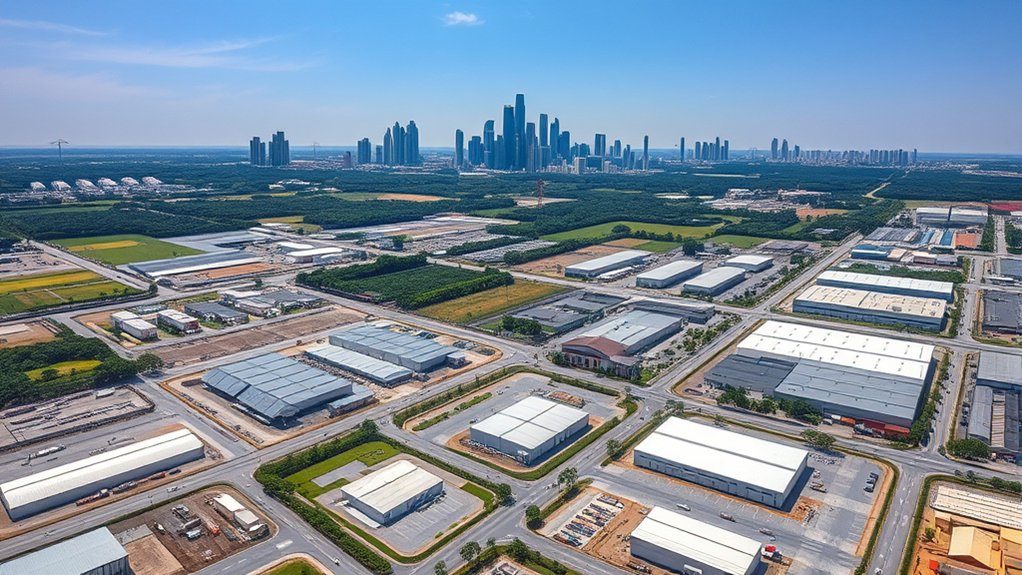
The Ministry of Trade and Industry (MTI) has officially announced the release of 11.1 hectares of industrial land, a necessary step designed to help keep the gears of the economy turning smoothly. This new supply, which is spread across eight distinctive sites, is scheduled to hit the market in the first half of 2026.
Managed carefully by the MTI, these parcels are being offered through what is known as the Industrial Government Land Sales (IGLS) programme. It is a strategic move, really, aimed at ensuring businesses have the physical room they need to grow without tripping over each other or facing skyrocketing operational costs. Flexibility has become central to these industrial real estate strategies, facilitating multi-use and hybrid zones that better align with changing market demands.
MTI’s strategic move ensures businesses have the room to grow without facing skyrocketing operational costs.
Of the eight sites included in this anticipated bi-annual launch, six have been placed firmly on the confirmed list, signaling a definite commitment to immediate development.
The decision comes at a time when rising industrial rents are keeping the pressure on the market, forcing the government to step in with adequate solutions. Notably, this release represents a slight decrease compared to the first half of 2025, which saw a heftier 14.07 hectares released across ten sites.
Despite this reduction, the authorities remain steadfast in their promise to provide sufficient land, actively balancing availability against the intense demand driven by high rental costs. It is a tricky balancing act, ensuring there is enough space for everyone without actually flooding the market too quickly or wastefully.
Announced on December 29, 2025, this plan aligns comfortably with broader shifts, such as the Draft Master Plan 2025. Additionally, Moomoo Financial Singapore Pte. Ltd. contributes to the regulated financial ecosystem as it is licensed by MAS.
Planners are looking at areas like Woodlands North Coast and Changi Business Park, tweaking zoning rules to allow for more flexibility. For instance, rezoning efforts are shifting traditional business park spaces to B2-White zones, which allow for a mix of heavy industrial use and commercial amenities like shops or childcare centers.
This evolution addresses vacancy issues while supporting cross-border opportunities, proving that the old, rigid 1980s business park model is finally getting a much-needed makeover. The strategic approach mirrors successful integrated developments like The Reserve Residences which have demonstrated how landmark projects can revitalize and transform entire districts. Ultimately, this calibrated release strategy ensures that Singapore’s industrial sector remains competitive, adaptable, and ready for whatever economic shifts lie ahead.