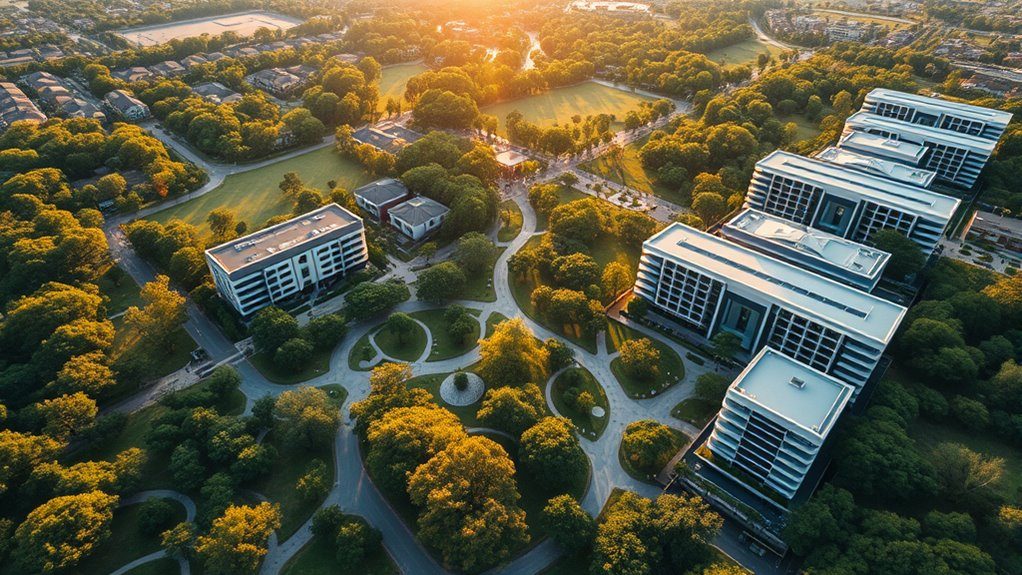
Woodlands is undergoing the most comprehensive urban rejuvenation in its history. Under the Urban Redevelopment Authority (URA) Draft Master Plan 2025, the northern town is transitioning from a traditional residential satellite town into Singapore’s Northern Regional Centre and a premier agritech and industrial innovation gateway. This multi-decade transformation is underpinned by two primary catalysts: innovative flexible zoning policies at Woodlands North Coast and major cross-border rail infrastructure anchored by the Johor Bahru–Singapore Rapid Transit System (RTS) Link.
State planners have outlined an integrated strategy that balances economic vitality with sustainable community living. The national blueprint coordinates employment clusters, rapid transport connections, and high-quality residential precincts to create a self-sustaining regional metropolis. Complementing this vision, state initiatives such as the JTC Woodlands Gateway District in support of the SEZ illustrate how national statutory bodies are translating regional master plans into physical industrial and business clusters.
The Strategic Vision for Woodlands Regional Centre
The URA Master Plan establishes Woodlands Regional Centre as the primary economic hub of Singapore’s Northern Agri-Tech and Food Corridor. Encompassing over 100 hectares of developable land, the precinct is divided into two distinct yet complementary districts: Woodlands Central and Woodlands North Coast.
Woodlands Central serves as the commercial heart, centered around Woodlands MRT interchange station, Causeway Point, and Woods Square. It provides commercial office spaces, civic amenities, and retail services for the wider northern population. Meanwhile, Woodlands North Coast is master-planned as a waterfront business, industrial, and innovation precinct overlooking the Straits of Johor.
As outlined in the statutory guidelines of the Urban Redevelopment Authority Master Plan, the decentralisation of commercial activity away from the Central Business District to regional centres reduces peak-hour commuting congestion and brings quality employment opportunities closer to homes across the island.
Flexible B2-White Industrial Zoning at Woodlands North Coast
A central planning breakthrough introduced in the Draft Master Plan is the implementation of flexible B2-White zoning across strategic plots in Woodlands North Coast. Traditional industrial zoning strictly delineates between light industrial (B1), general industrial (B2), and commercial activities, often creating rigid corporate parks that lack vitality outside standard office hours.
In contrast, B2-White zoning introduces a hybrid planning mechanism. Developers can integrate general industrial and manufacturing activities with non-industrial uses—such as commercial offices, retail outlets, food courts, and childcare centres—subject to minimum baseline plot ratios. For instance, in parcels designated with specific ratios like 4.2 [B-2.5] W, developers must reserve a gross plot ratio of at least 2.5 for core industrial activities, while retaining the freedom to allocate the remaining allowable gross floor area to commercial and communal uses.
This flexible framework supports modern high-value sectors, including semiconductor manufacturing, biomedical logistics, precision engineering, and agrifood research. It fosters dynamic mixed-use business environments where employees can work, collaborate, and access essential lifestyle amenities within a single integrated precinct.
Johor Bahru-Singapore RTS Link and Cross-Border Transit
Physical connectivity serves as the backbone of the Woodlands transformation. The Johor Bahru–Singapore Rapid Transit System (RTS) Link, connecting Woodlands North MRT station to Bukit Chagar in Johor Bahru, represents a transformative cross-border transport link. Capable of transporting up to 10,000 passengers per hour in each direction, the 4-kilometre rail shuttle will significantly alleviate congestion across the Causeway.
Co-located customs, immigration, and quarantine (CIQ) facilities at both terminal stations ensure streamlined passenger clearance. The impact of this rapid cross-border transit on local traffic and housing is examined in our analysis of how the Johor-Singapore RTS Link transforms Woodlands. Direct rail connectivity deepens economic collaboration under the Johor-Singapore Special Economic Zone (JS-SEZ), enabling multinational enterprises to base regional management and research functions in Singapore while scaling manufacturing facilities in Johor.
Woodlands North MRT station also connects directly into the Thomson-East Coast Line (TEL), which traverses southward through Lentor, Caldecott, Orchard, Shenton Way, and Marina Bay, as highlighted by the Land Transport Authority rail network expansion.
Expanding Public and Private Housing in Woodlands
To support economic expansion, the government is delivering a diversified pipeline of residential developments across Woodlands. New public housing Build-To-Order (BTO) estates are integrated with green waterfront park connectors, modern neighborhood centers, and healthcare polyclinics under housing programmes overseen by the Ministry of National Development.
In the private and executive condominium sector, prime land releases have drawn significant developer interest. A prominent example is Wynwood Grand, the upcoming executive condominium at Woodlands Drive 17. As an executive condominium grandfathered under favorable booking and deferred payment schemes, Wynwood Grand caters to local HDB upgraders seeking modern condominium facilities near future transit corridors.
The combination of affordable entry pricing, strong employment drivers, and expanding rail networks makes residential property in Woodlands increasingly attractive to both owner-occupiers and long-term property investors seeking stability and long-term capital preservation.
The expansion of commercial and industrial floor space in Woodlands aligns directly with Singapore’s economic decentralisation policy. By creating substantial employment nodes outside the central area, the urban blueprint reduces peak-hour congestion on southward transport corridors. Skilled residents in the north can access quality jobs in engineering, research, and regional logistics without spending an hour commuting to the central business district every day.
Green Corridors and the North-South Connectivity Network
Liveability remains central to the Woodlands master plan. Comprehensive park connector networks link the town’s residential estates to Admiralty Park, Woodlands Waterfront Park, and the central Rail Corridor. The 24-kilometre Rail Corridor allows cyclists and pedestrians to travel seamlessly from Woodlands southwards through Bukit Timah to Tanjong Pagar.
On the road transit front, the upcoming North-South Corridor (NSC)—Singapore’s first integrated transport corridor featuring dedicated bus lanes, cycling trunk routes, and vehicular expressways—will significantly reduce commuting times between Woodlands and the downtown core. Through coordinated transit links, innovative zoning, and balanced residential growth, Woodlands is cementing its position as a vibrant, forward-looking northern gateway for Singapore.


