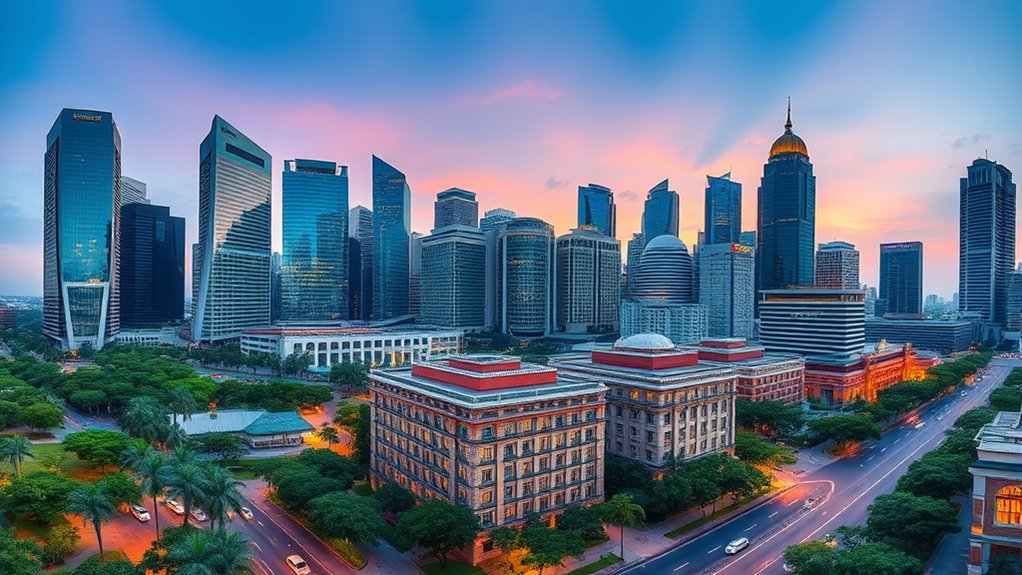
What does it take to buy commercial property in Singapore, and why does it matter to investors? Commercial property comes in several primary categories, including office spaces, retail shops, industrial buildings, warehouses, and hotels. It is classified as non-residential use, so zoning and usage rules differ from residential property, and mixed-use sites often follow residential zoning, which can tighten foreign ownership limits.
Additionally, no ABSD applies to commercial property acquisitions, which reduces upfront costs for both foreigners and locals.
The Urban Redevelopment Authority (URA) defines allowable uses and redevelopment potential. Demand is strong in central areas, especially CBD offices and centrally located retail, with solid rental yields and capital appreciation. Large developers like UOL and CapitaLand actively pursue significant acquisitions in Singapore’s competitive real estate market.
Foreign ownership and regulatory framework: Foreigners are allowed to purchase most commercial properties, including shophouses for commercial use, hotels, and industrial or office spaces. The Residential Property Act imposes few restrictions on foreign commercial property ownership, and there is no ABSD on commercial properties for either foreigners or locals.
Foreigners may buy most commercial properties in Singapore—no ABSD applies to commercial assets.
This means that URA zoning decisions directly affect what you can do with a property.
However, mixed-use properties can pose constraints if residential zoning dominates, so investors must check the zoning classification before negotiating. Singapore positions itself as a global hub for foreign investment in commercial real estate.
Financial considerations and costs: The Buyer’s Stamp Duty is applied progressively, starting at 1% for the first S$180,000, 2% for the next S$180,000, 3% for the next S$640,000, 4% for the next S$500,000, and 5% beyond.
ABSD is not applicable on commercial property, creating cost advantages. Property tax on commercial property runs at about 10% of the annual value, roughly the estimated market rent. GST of 9% applies on new commercial property purchases, payable at completion. Seller’s Stamp Duty may apply if a property is sold within a designated holding period.
Location and districts: Singapore has 28 districts, grouped as CCR, RCR, and OCR. CCR offers yields, the RCR blends accessibility with mature estates, OCR provides options.
Zoning, usage, and restrictions: URA zoning governs property use and redevelopment, and district plans may impose usage restrictions or guide renovations.
Redevelopment potential depends on the zoning class, so not all commercial properties can be converted in use or structure. Overall, buyers should verify zoning, occupancy types, and regulatory compliance to avoid surprises.