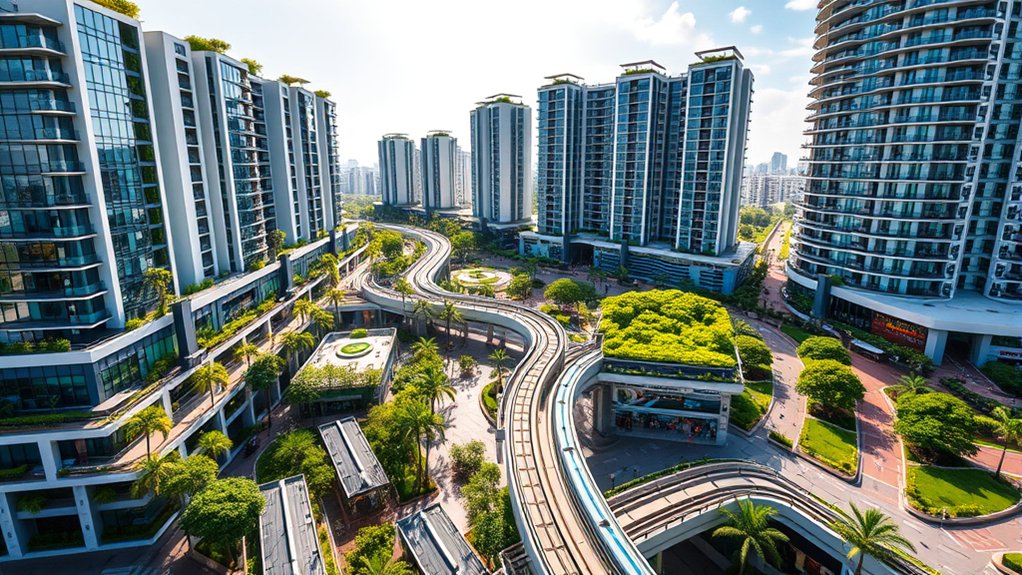
Bukit Timah Turf City is moving from a long-held planning reserve into a major new housing precinct. The scale is substantial: the authorities envisage approximately 15,000 to 20,000 public and private homes, delivered progressively over 20 to 30 years. That will introduce a broader housing mix, new transport links and more amenities into an established part of Bukit Timah.
Those plans matter to homebuyers in and around Districts 10 and 11, but they do not prove that nearby property values have already risen because of redevelopment. Construction will be phased, individual projects will differ, and future prices will still depend on supply, demand, interest rates, tenure, unit attributes and the wider market. Buyers should focus on how the confirmed changes may alter the area over time rather than assuming guaranteed appreciation.
A new estate planned over several decades
The former racecourse site covers about 176 hectares and had been safeguarded mainly for residential use since the 1998 Master Plan. URA’s Bukit Timah Turf City plan now sets out an inclusive estate with public and private housing, greenery, community facilities and transport connections.
The long completion horizon is important. This is not a single project that arrives on one completion date. Development is intended to begin near existing transport nodes along Dunearn Road and spread through the wider site in stages. Residents may therefore experience a mixture of completed homes, active works and parcels awaiting release for many years.
This will be the first new public housing in Bukit Timah in almost 40 years. A larger range of housing types could broaden the resident base and support more everyday services. However, the precise mix, launch dates, eligibility rules and pricing of future public housing should be assessed only when the relevant agencies announce each project.
Transport is a central part of the plan
The estate is designed around the existing Downtown Line and the future Turf City station on Cross Island Line Phase 2. URA intends residents to be within about a 10-minute walk of an MRT station, with buses supporting first- and last-mile journeys. Walking and cycling routes are planned as part of a car-lite layout, while reduced parking provision should free more land for homes, greenery and shared spaces.
According to the Land Transport Authority’s Cross Island Line update, Phase 2 comprises six underground stations and is scheduled to open by 2032. King Albert Park will connect the Cross Island and Downtown lines, while Clementi will provide an interchange with the East-West Line. Civil construction has started, but 2032 remains a future target rather than an operating service today.
Road capacity is part of the equation too. Widening of Eng Neo Avenue, Dunearn Road and Bukit Timah Road is being studied, alongside bus improvements. Buyers comparing locations should look beyond straight-line distance to a future station. The eventual entrance, walking route, gradient, road crossings and construction phasing can all affect practical accessibility. Our guide to new housing areas near MRT stations explains why an announced station and a completed, convenient journey are not the same thing.
Heritage and nature will shape the neighbourhood
Turf City is not planned as a blank-slate redevelopment. URA proposes conserving 22 heritage buildings, including the North and South Grandstands, and rejuvenating them as community nodes. The former Dunearn Water Depot is also proposed for conservation. A large central open space referencing the old racecourse is intended to preserve a visible link with the site’s equestrian history.
Environmental studies identified important habitats around Eng Neo Avenue Forest and Bukit Tinggi. Plans include retaining most of these forested areas and creating a 100-metre-wide planted connection between them. New neighbourhood parks and selected former Turf Club landscapes are expected to add recreational space.
These commitments may produce a distinctive setting, but many amenities remain under study. Retail, food and beverage uses, sports facilities, a school, healthcare services and a bus interchange appear in the planning vision; they should not all be treated as confirmed, completed facilities. Buyers should check the latest approved plans for the specific parcel and its surroundings rather than rely only on an artist’s impression.
Land sales show implementation has begun
The clearest evidence of implementation is along Dunearn Road. URA awarded the first residential site in July 2025 for S$491.45 million, equivalent to about S$1,410 per square foot per plot ratio. The 99-year leasehold parcel can yield about 380 homes and subsequently became Dunearn House.
A second Dunearn Road parcel, planned for about 330 homes with commercial space on the first storey, was awarded in May 2026 for approximately S$533 million, or about S$1,625 psf ppr. These awards confirm that private housing supply is entering the pipeline. They do not establish the sale prices of future units, which also reflect construction costs, financing, design, marketing and the developer’s margin.
Dunearn House launched in July 2026 and sold 212 of 380 units during its launch weekend at an average of S$3,140 psf. The result, covered in our July 2026 new-home sales analysis, is a useful observed benchmark for one project. It is not evidence that every existing home in District 10 or 11 has experienced the same price movement.
What the redevelopment could mean for nearby homes
Over time, more convenient rail access, new shops, parks and community facilities could improve everyday liveability for some nearby residents. A larger population may support a wider range of services, while the new public-private housing mix could create more options for households wishing to remain near Bukit Timah.
There are counterweights. Thousands of new homes also mean more competition when owners sell or rent. Construction can bring noise, dust, diversions and heavy-vehicle traffic. Car-lite planning and fewer parking spaces may not suit every household. Existing condominiums will also differ in age, maintenance, tenure, layout and actual walking access to stations, so broad district averages can conceal more than they reveal.
District labels deserve caution as well. Turf City’s effects will not stop neatly at a postal boundary, and proximity alone does not create a uniform price response. Homes closest to works may face short-term disruption, while those near completed transport or amenities may benefit more from convenience. Any forecast should therefore be parcel-specific and time-specific.
A practical checklist for buyers and owners
- Separate current facilities from future plans. Verify what is open now, what is under construction and what remains under study.
- Map the real journey. Check planned station entrances and safe walking routes rather than relying on a radius drawn around the site.
- Review the supply pipeline. Compare upcoming public and private parcels with the unit type you may eventually sell or rent.
- Allow for a long build-out. Consider whether your intended holding period overlaps with major construction or completion milestones.
- Compare like with like. Use recent transactions for similar tenure, age, size and condition; a new-launch average is not a direct valuation for an older resale home.
- Stress-test the purchase. Affordability should work without assuming a future MRT station or master-plan announcement will deliver a particular capital gain.
Turf City is one of Bukit Timah’s largest announced changes, and the first land awards show that delivery has started. Its full effect, however, will unfold unevenly over decades. Buyers will be better served by tracking confirmed infrastructure, parcel releases and comparable transactions than by treating redevelopment as an automatic uplift for every property in Districts 10 and 11.